

What You Must Know Before Building a Multi-Million Dollar Custom Estate
Comparing Delivery Models of Custom Home Builders Luxury Teams
Before building a multi-million-dollar custom estate, you must know four core essentials: selecting the right project delivery structure (integrated design-build vs. architect partnerships), verifying your builder’s financial stability and municipal track record, locking in transparent open-book or Guaranteed Maximum Price accounting, and requiring digital management systems for remote oversight. Establishing these fundamentals early ensures complex architectural concepts are engineered accurately, permitted smoothly, and delivered without budget blowouts.
When building an estate from a blank canvas, your delivery model shapes every milestone. In the high-end residential sphere, delivery structures generally fall into three categories: fully integrated design-build, external architectural partnerships, and luxury production or semi-custom programs.
| Feature / Metric | Fully Integrated Design-Build | Architect & Builder Partnership | Luxury Production / Semi-Custom |
|---|---|---|---|
| Design Flexibility | 100% bespoke; blank-slate architecture | 100% bespoke; custom design | Modified catalog plans; set options |
| Contract Structure | Single entity; unified design & build | Two separate contracts | Single entity; standard package contract |
| Cost Transparency | Open-book or guaranteed maximum price | Variable bid pricing per trade | Fixed catalog pricing with upgrade menus |
| Schedule Control | Overlapped design & permitting | Sequential; handoff gaps possible | Predetermined construction phases |
| Site Adaptation | Complex topography, custom grading | High adaptation to unique parcels | Flat or lightly graded parcels |
| Accountability | Single source of project responsibility | Split between design and field execution | Single builder point of contact |
Understanding these distinctions is fundamental to choosing the right high-end residential builders for complex custom estates. While production builders excel at delivering volume, an architectural custom build demands a team that treats engineering, materials, and regional terrain as unique variables.
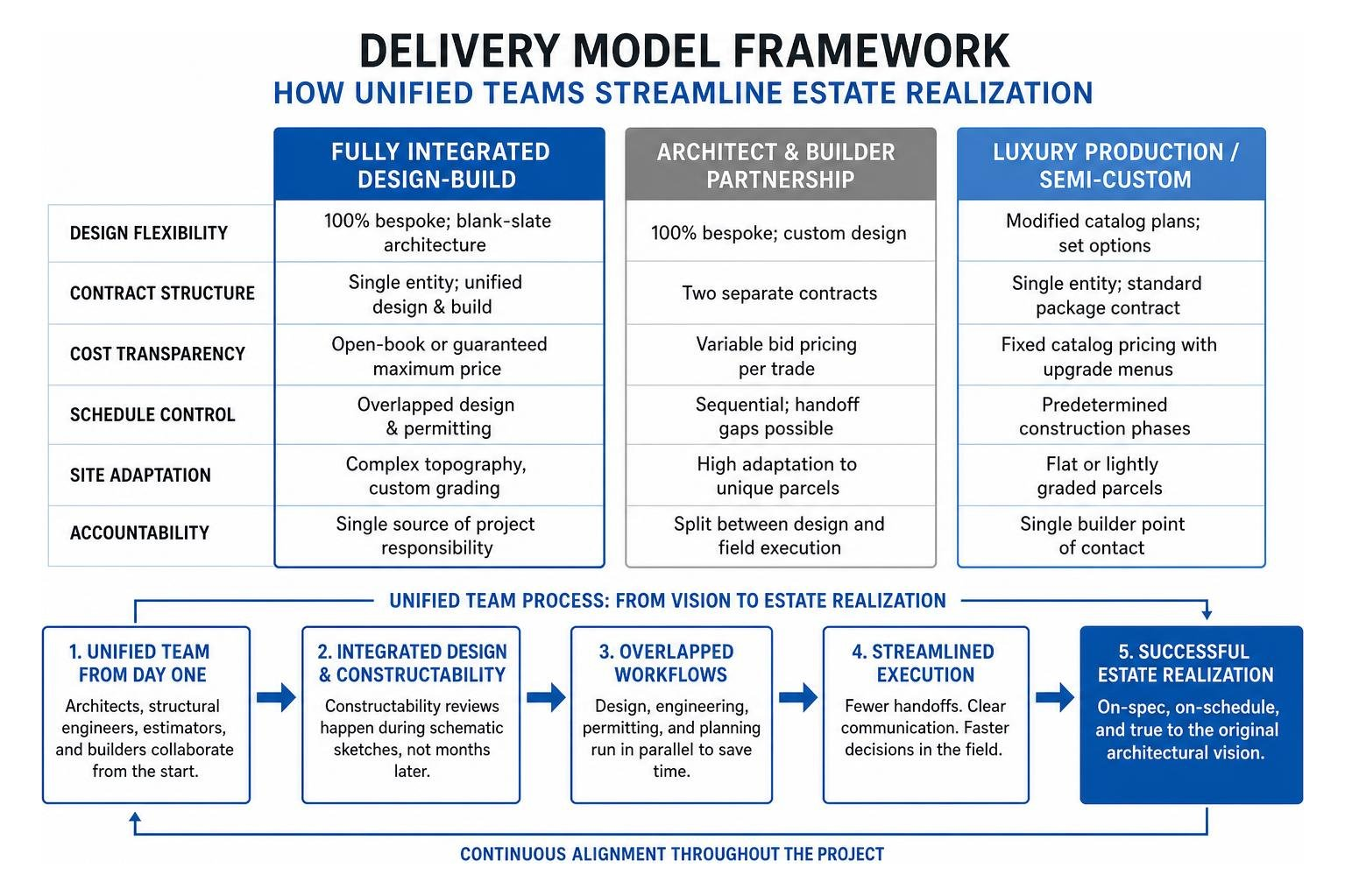
Architect-Led Integration vs Builder Partnerships
True bespoke estates require continuous conversation between design creativity and structural reality. Architect-led design-build models bring structural engineers, site estimators, and licensed architects into the room from day one.
When a design team works hand-in-hand with field builders, constructability reviews happen during schematic sketches rather than months later during framing. This dynamic protects the architectural integrity of cantilevered rooms, expansive glazing, and specialized structural steel systems.
Collaborative partnerships between dedicated builders and external American Institute of Architects (AIA) professionals achieve a similar synergy, provided open channels exist before submitting construction documents to municipal building departments. By resolving complex details—such as seismic anchoring, thermal bridges, and site retention—early, the team accelerates permitting and prevents redesign delays.
The Financial Advantages of Single-Team Accountability
Fragmented contracts frequently lead to finger-pointing when unexpected ground conditions or framing anomalies appear. When you operate under separate design and construction agreements, design omissions can spark costly change orders that delay milestones.
Single-team delivery bridges this gap by unifying responsibility under one roof. Schedule compression occurs naturally because site prep, grading permits, and long-lead material procurement can be initiated while interior finish schedules are finalized.
This cohesive management structure eliminates administrative overlap, keeps contingencies intact, and is essential for navigating luxury home construction without stress or budget blowouts.
Critical Credentials to Verify Before Signing an Estate Contract
Building an architectural landmark requires financial resilience, technical expertise, and deep knowledge of municipal regulations. Evaluating a team goes beyond reviewing marketing portfolios; it requires verifying field-tested systems.
When vetting custom home builders luxury candidates, evaluate these critical areas:
- Financial Integrity and Balance Sheet Strength: High-end estates involve substantial cash flow. A builder must possess healthy banking relationships, strong bonding capacity, and verified trade-partner accounts to keep materials flowing without interruption.
- Transparent Accounting Methods: Top firms use open-book accounting or well-defined guaranteed maximum price structures, sharing actual subcontractor bids, material invoices, and lien waivers.
- Local Municipal and Regulatory Track Record: Navigating regional coastal commissions, hillside ordinances, environmental impact reviews, and strict wildland-urban interface building codes requires seasoned local expertise.
- Longstanding Artisan Networks: Exceptional estates rely on master framers, architectural metalworkers, and finish carpenters who work consistently with the builder.
What Top Custom Home Builders Luxury Portfolios Reveal About Craftsmanship
A portfolio should demonstrate structural precision alongside stunning photography. Look closely at how materials meet: flush baseboards, shadow reveal details, zero-threshold pocket doors, and book-matched stone slabs require exact framing tolerances that average builders cannot achieve.
Take time to review curated luxury estate projects across diverse architectural styles. A deep portfolio proves a team can adapt to complex engineering demands, whether building a modern glass pavilion or a classic heritage residence.
Green Building Standards and Modern Engineering
Luxury in 2026 is intimately tied to building performance, energy independence, and indoor environmental quality. A luxury estate should operate with clean efficiency behind its finished walls.
We integrate sustainable building principles from the initial massing studies. Incorporating LEED-certified strategies, net-zero energy infrastructure, solar-plus-storage microgrids, advanced thermal breaks, and low-VOC sustainable materials creates a comfortable living environment that lowers operating costs and stands up to environmental demands.
Essential Technologies for Remote Owner Oversight and Transparency
Many estate owners manage projects while traveling, running enterprises, or living out of state. Reliable technology bridges the physical distance, offering complete visibility without requiring daily job-site visits.
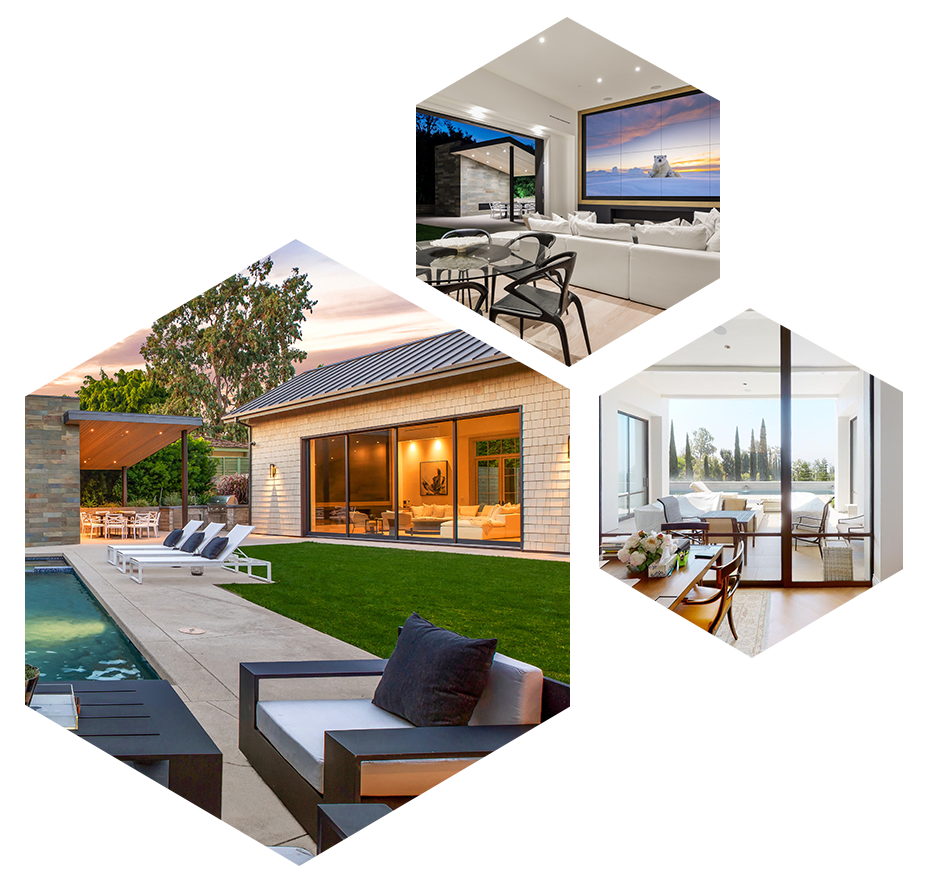
Modern luxury estate builders employ integrated management platforms that give you a live window into your build:
- Daily Visual Logs: High-resolution photo updates, drone site captures, and 360-degree interior scans document progress prior to insulation and drywall close-in.
- Interactive Cloud Dashboards: Centralized platforms track project schedules, weather adjustments, trade allocations, and procurement milestones in real time.
- Digital RFI and Submittal Tracking: Clear tracking for Requests for Information (RFIs) and shop drawing approvals keeps architectural decisions moving forward.
Real-Time Financial Tracking and Open-Book Reporting
Financial clarity prevents friction. We structure accounting so owners see where every dollar is deployed, contrasting real-time committed costs against original budget targets.
Through transparent milestone billing schedules, owners review progress alongside verified trade lien releases. This approach guarantees that contingencies are actively tracked and that long-lead finishes—from European stone to custom architectural fenestration—are procured on time. Understanding these operational realities is a cornerstone of everything you need to know about building a modern luxury home in Los Angeles.
Seamless Communication Protocols for Busy Estate Owners
Technology is most effective when supported by straightforward human communication. We establish dedicated communication channels tailored to your schedule:
- Weekly Virtual Walkthroughs: Live video tours hosted by your Project Executive to inspect physical progress and discuss upcoming details.
- Streamlined Decision Schedules: Curated selection timelines that flag critical path items weeks in advance, preventing decision fatigue.
- Centralized Digital Approvals: Simple digital sign-offs for finish selections, custom millwork drawings, and change orders.
Architectural Site Integration and Outdoor Living Systems
A custom estate should feel rooted in its natural landscape. Site integration shapes early grading plans, foundational engineering, and structural framing.
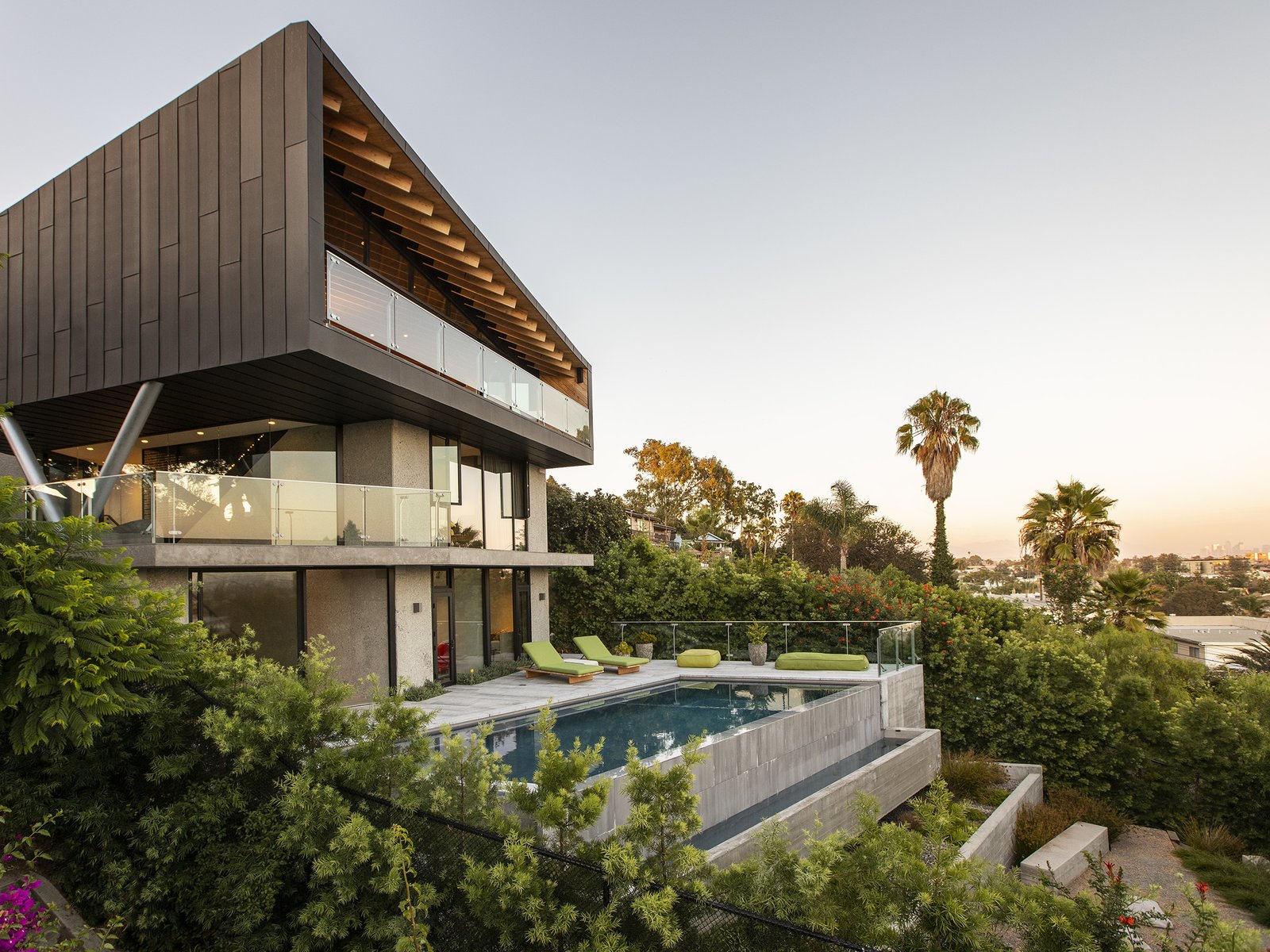
High-end outdoor spaces require the same engineering rigor as the main interior structure:
- Topographical and Microclimate Optimization: Orienting the estate’s footprint to capture prevailing breezes, optimize solar exposure, and frame natural vistas while buffering harsh winds.
- Integrated Structural Pools and Terraces: Engineering zero-edge swimming pools, cantilevered decks, and deep-foundation retaining walls as continuous extensions of the primary foundation.
- Disappearing Glass Enclosures: Recessing motorized multi-slide and pivot door tracks flush with interior flooring to create natural indoor-outdoor transitions.
- Resort-Level Exterior Living: Designing fully equipped outdoor culinary centers, architectural fire elements, automated shade pergolas, and native landscaping supported by smart water-reclamation systems.
Our tailored estate construction services balance these complex civil and structural elements to ensure your grounds function in harmony with your interior rooms.
Frequently Asked Questions About Luxury Custom Estates
How Do Custom Home Builders Luxury Contracts Prevent Budget Blowouts?
Budget overruns typically stem from incomplete architectural scopes, vague allowance figures, and delayed decision-making. Top-tier builders prevent this through comprehensive pre-construction discovery.
By performing thorough geotechnical reviews, completing structural engineering reviews early, and utilizing fixed-price or open-book Guaranteed Maximum Price (GMP) contracts with clearly outlined scope descriptions, surprises are minimized. Transparent contingency funds and formal, written change-order procedures ensure that any design modifications are priced, scheduled, and approved before field work begins.
How Long Does a Multi-Million Dollar Custom Estate Take to Complete?
A bespoke estate generally requires between 18 and 36 months from initial concept to move-in, depending on site complexity, architectural scale, and local entitlement timelines.
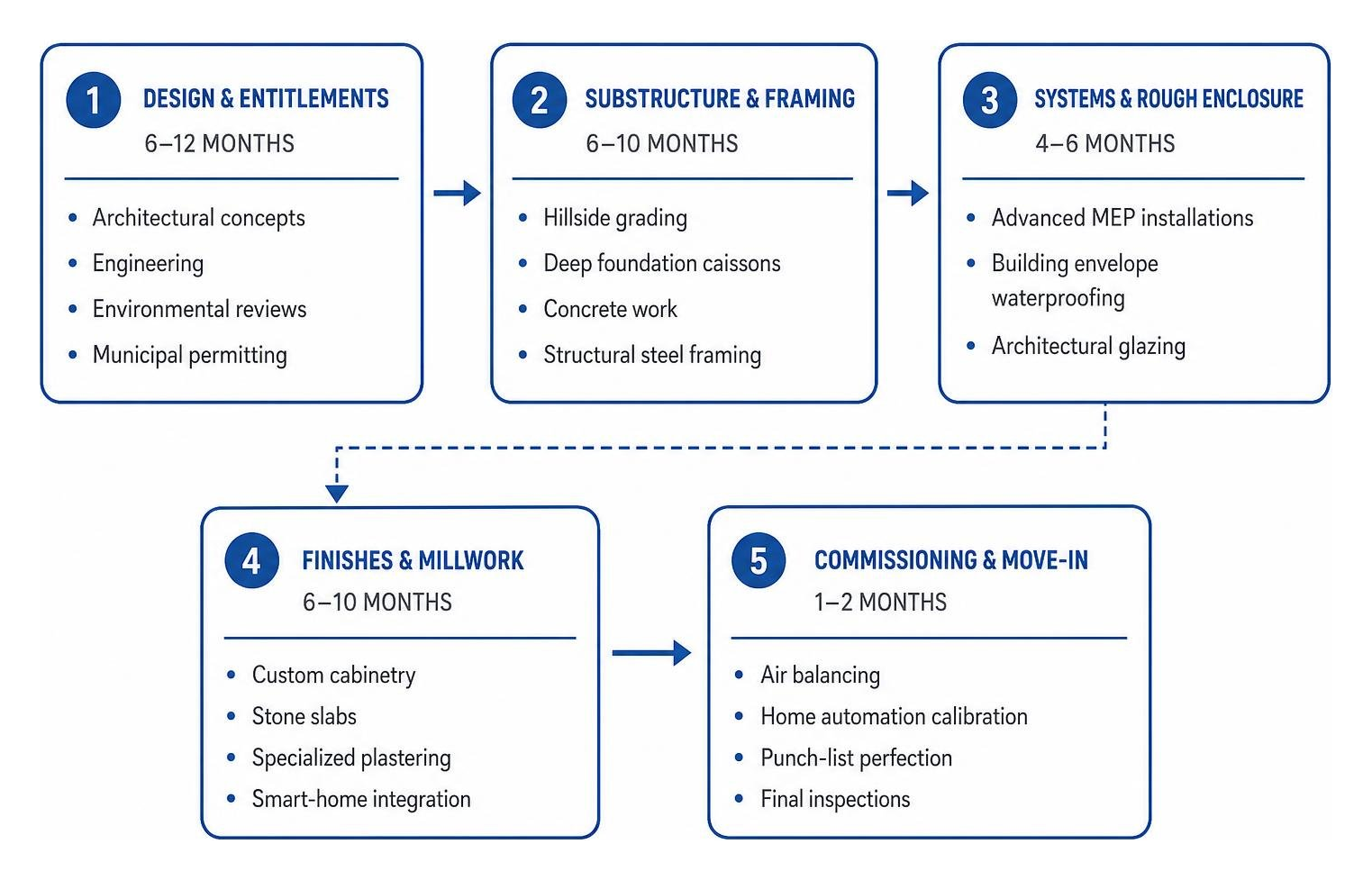
- Design & Entitlements (6–12 Months): Architectural concepts, engineering, environmental reviews, and municipal permitting.
- Substructure & Framing (6–10 Months): Hillside grading, deep foundation caissons, concrete work, and structural steel framing.
- Systems & Rough Enclosure (4–6 Months): Advanced MEP (mechanical, electrical, plumbing) installations, building envelope waterproofing, and architectural glazing.
- Finishes & Millwork (6–10 Months): Custom cabinetry, stone slabs, specialized plastering, and smart-home integration.
- Commissioning & Move-In (1–2 Months): Air balancing, home automation calibration, punch-list perfection, and final inspections.
What Role Does In-House Interior Design Play in Custom Builds?
Integrating interior design within the construction team ensures that spatial proportions, architectural lighting, electrical layouts, and custom millwork coordinate smoothly with structural framing.
This alignment prevents on-site spatial conflicts, simplifies long-lead material procurement, and ensures that ceiling reveals, electrical switch placements, and custom material transitions match the overarching architectural design.
Conclusion
Building a multi-million-dollar estate is a creative and financial milestone. The journey should be as rewarding and transparent as the final residence.
At Scanlon Construction, we combine more than 30 years of building craftsmanship, sustainable design-build execution, and close architect partnerships to build residences of enduring quality. If you are ready to bring your vision to life, partner with premier luxury estate builders who have the skill, dedication, and precision to deliver your legacy home.