

High-End Builders of Luxury Homes That Turn Complex Blueprints into Masterpieces
How to Choose Builders of Luxury Homes for a Complex Custom Project
The best builders of luxury homes do more than install premium finishes. They turn your architectural vision into a well-managed, durable home by coordinating design, engineering, permits, skilled trades, materials, and every fine detail.
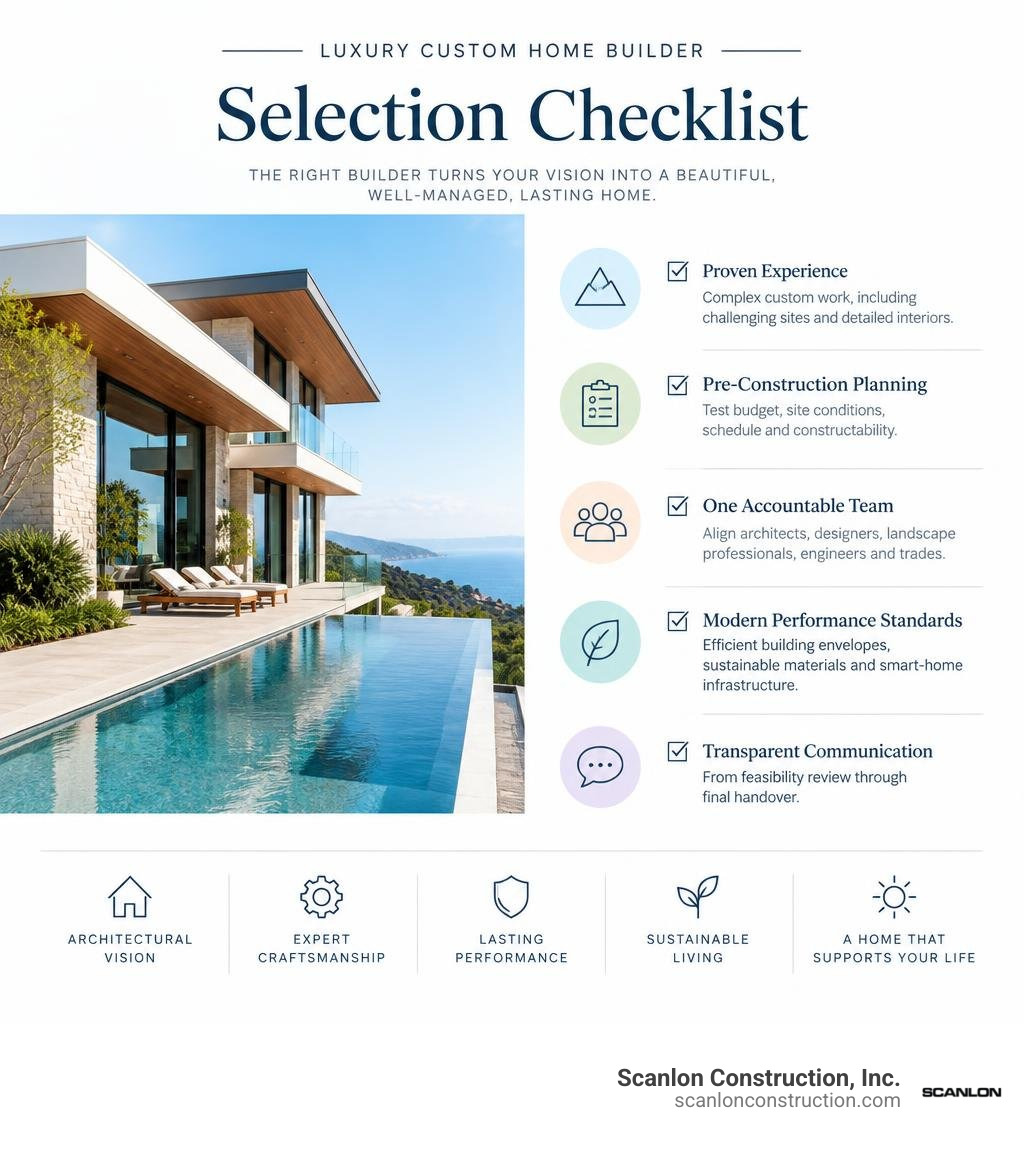
For an affluent Southern California homeowner, look for a builder that offers:
- Proven experience with complex custom work, including hillside sites, large openings, structural steel, and detailed interiors
- Clear pre-construction planning that tests budget, site conditions, schedule, and constructability before building begins
- One accountable team to align architects, interior designers, landscape professionals, engineers, and specialty trades
- Modern performance standards, including efficient building envelopes, sustainable materials, and smart-home infrastructure
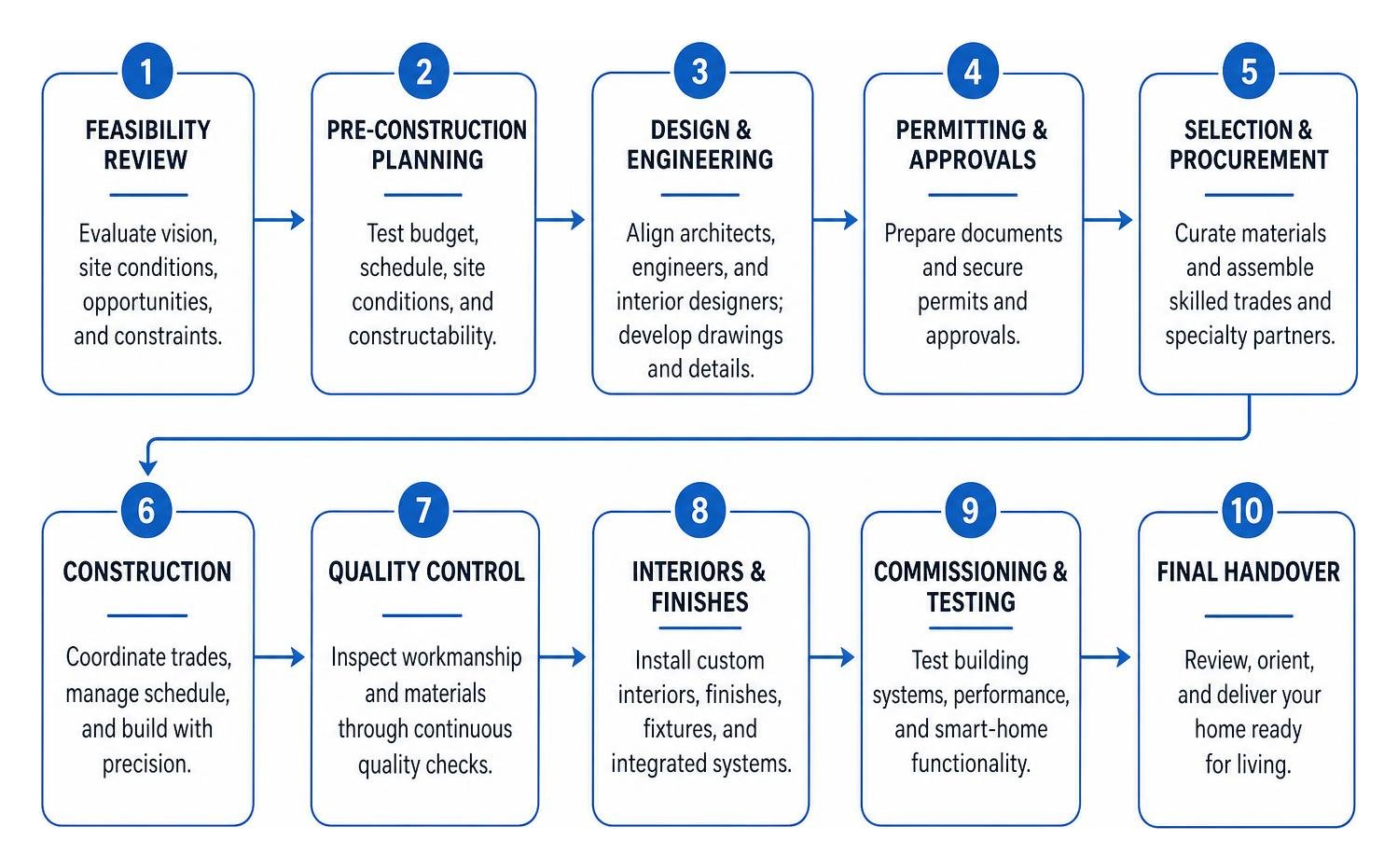
- Transparent communication and quality control from the first feasibility review through final handover
Luxury is not defined by marble alone. It is the alignment of design, craftsmanship, performance, and the way a home supports its owner’s life. The right builder brings those moving parts together without losing the intent behind the blueprint.
Key builders of luxury homes vocabulary:
What Sets Leading Builders of Luxury Homes Apart from Standard Contractors
When embarking on a legacy build, the gap between a standard general contractor and an elite estate builder quickly becomes apparent. Standard residential contracting is fundamentally transactional. It relies on standard assemblies, catalogue specifications, and conventional production schedules. In contrast, crafting an architecturally significant estate requires an artisan mindset coupled with deep technical fluency.
Elite builders understand that site feasibility must be thoroughly investigated long before heavy equipment arrives on the parcel. Geotechnical anomalies, hydrological dynamics, and microclimate considerations dictate structural strategies. Furthermore, transparent pricing models replace the vague allowances that routinely plague standard construction. Rather than guessing finish allowances, top-tier builders run exhaustive pre-construction cost modeling, curating bespoke materials and verifying trade partner capacities.
Artisan curation means every material is sourced with intent:
- Hand-selected stone slabs inspected at the quarry for exact vein matching
- Custom architectural millwork dried to site-specific equilibrium moisture content
- Thermally broken steel window profiles engineered to withstand coastal marine environments
- Sustainably harvested structural timbers hand-fitted with mortise-and-tenon precision
Single-Point Accountability vs. Fragmented General Contracting
The traditional design-bid-build model places the homeowner squarely between an architect and an independent general contractor. When blueprints meet physical field obstacles, this fragmented structure frequently leads to finger-pointing, expensive change orders, and schedule delays.
It is clear why Los Angeles homeowners are ditching traditional general contractors in favor of unified project delivery. Single-point accountability unites the entire ecosystem—structural engineers, interior designers, landscape architects, and master trades—under one responsible roof.
By integrating the builder during early concept development, constructability analyses occur parallel to aesthetic design. Cost overruns are prevented rather than mitigated after the fact, providing absolute risk management and total transparency from grading to final commissioning.
Boutique Founder-Led Teams vs. National Volume Builders
While publicly traded national homebuilders excel at delivering standardized tract subdivisions across sprawling master-planned developments, bespoke estate construction requires an entirely different operational philosophy. National corporate entities manage hundreds of active sites simultaneously, handing clients off between regional managers, procurement officers, and junior superintendents.
In contrast, boutique, founder-led teams purposely cap their active project intake—often handling only a select handful of custom residences annually. This guarantees direct executive involvement on-site, deep trade loyalty, and white-glove client concierge service.
| Feature | Boutique Founder-Led Builders | National High-Volume Builders |
|---|---|---|
| Annual Project Volume | Strictly capped (typically 3–8 active builds) | Hundreds to thousands of units |
| On-Site Leadership | Principal / Founder actively walks job sites | Rotating field superintendents |
| Design Flexibility | 100% bespoke, zero catalog constraints | Pre-selected option packages |
| Trade Craftsmanship | Master artisans and hand-picked specialists | Lowest-bid commercial subcontractors |
| Client Communication | Dedicated executive concierge; weekly video logs | Tiered customer support portals |
| Engineering Rigor | Custom hillside, seismic, and envelope solutions | Standardized structural packages |
Navigating Complex Engineering and High-End Architectural Ecosystems
High-end modern architecture frequently pushes the physical boundaries of residential construction. Expansive cantilevered living spaces, vast subterranean wellness centers, structural glass curtain walls, and vanishing threshold sliders require rigorous mechanical, electrical, and plumbing (MEP) coordination alongside high-tolerance framing.
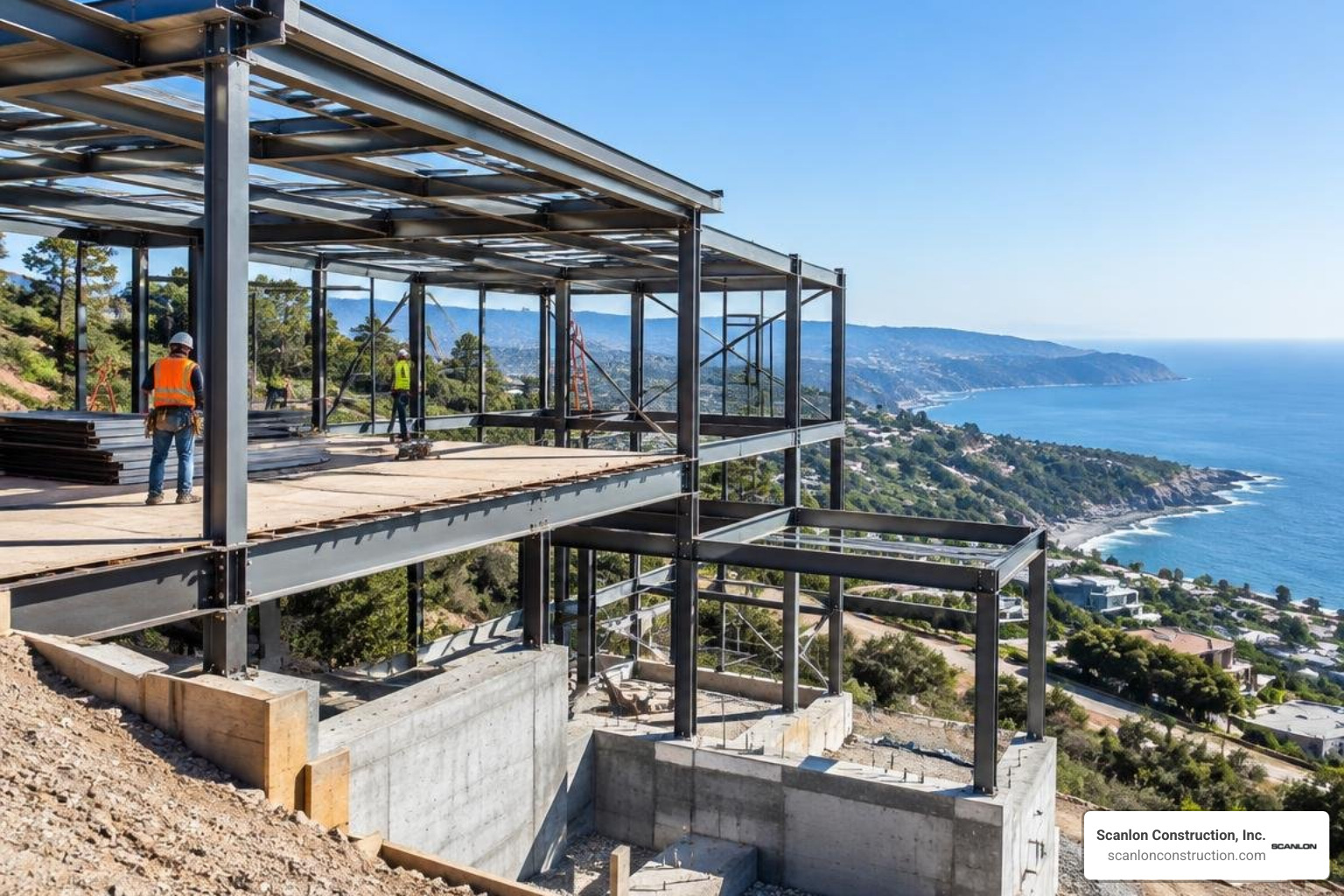
How Builders of Luxury Homes Execute Complex Architectural Engineering
Executing high-concept residential designs demands structural engineering expertise far beyond basic wood framing. Hillside parcels across coastal regions, Texas Hill Country developments, and mountain enclaves require deep foundation mastery.
When building on difficult topography, knowing why building a Bel Air custom home demands specialized engineering becomes critical. Foundation packages regularly incorporate:
- Friction Piles and Caissons: Drilled 40 to 90 feet into bedrock to anchor the structure against seismic activity and lateral soil pressures.
- Cast-in-Place Shotcrete Retaining Systems: Engineered with subterranean drainage mats and waterproofing membranes to prevent hydrostatic intrusion.
- Moment-Resisting Structural Steel Skeletons: Fabricated to millimetric tolerances, enabling column-free interior spans that exceed 50 linear feet.
- Specialty Deflection Engineering: Ensuring expansive floor-to-ceiling multi-slide glass systems operate smoothly under shifting seasonal loads.
Orchestrating Multi-Disciplinary Architect and Designer Collaborations
A luxury residence is a complex synthesis of architecture, interior styling, lighting design, and landscape integration. Without meticulous builder coordination, trade collisions are inevitable. Elite builders bridge this gap by managing complex custom architecture through high-end design-build teams.
By managing 3D Building Information Modeling (BIM) clashes before rough-in phases commence, we guarantee that recessed lighting fixtures, concealed linear HVAC diffusers, automated solar shades, and architectural reveals align perfectly without compromising structural integrity or mechanical airflow.
Modern Standards: Smart Integration, Sustainable Building, and Material Excellence
Today’s premier estates demand holistic performance. True luxury is quietly felt: uninterrupted indoor air purification, perfectly balanced acoustic dampening, continuous thermal comfort, and intuitive digital automation that operates effortlessly in the background.

Modern sustainable luxury encompasses:
- High-Performance Building Envelopes: Continuous exterior insulation, air-barrier wraps, and triple-pane low-E glazing systems that eliminate thermal bridging and drastically lower heating/cooling demands.
- Decarbonization & Clean Energy: Whole-home solar photovoltaic arrays paired with centralized commercial-grade battery backup storage systems (e.g., Tesla Powerwall or Enphase configurations).
- Passive Solar & Biophilic Design: Deep roof overhangs calibrated to seasonal sun angles, optimizing natural daylight while incorporating principles of biophilic design to seamlessly connect indoor and outdoor spaces.
- Centralized Low-Voltage Automation: Enterprise-grade Lutron, Crestron, or Savant platforms integrating circadian lighting rhythms, automated motorized shading, climate management, and multi-zone audio/video networks.
- Advanced Indoor Environmental Quality (IEQ): Dedicated Energy Recovery Ventilators (ERV) combined with MERV-16 or hospital-grade HEPA filtration to supply continuous, conditioned fresh air throughout the home.
Investment Benchmarks, Timelines, and Risk Mitigation for Custom Estates
Constructing an ultra-luxury residence is an extensive capital investment requiring disciplined financial oversight, comprehensive insurance structures, and strict project milestone tracking.
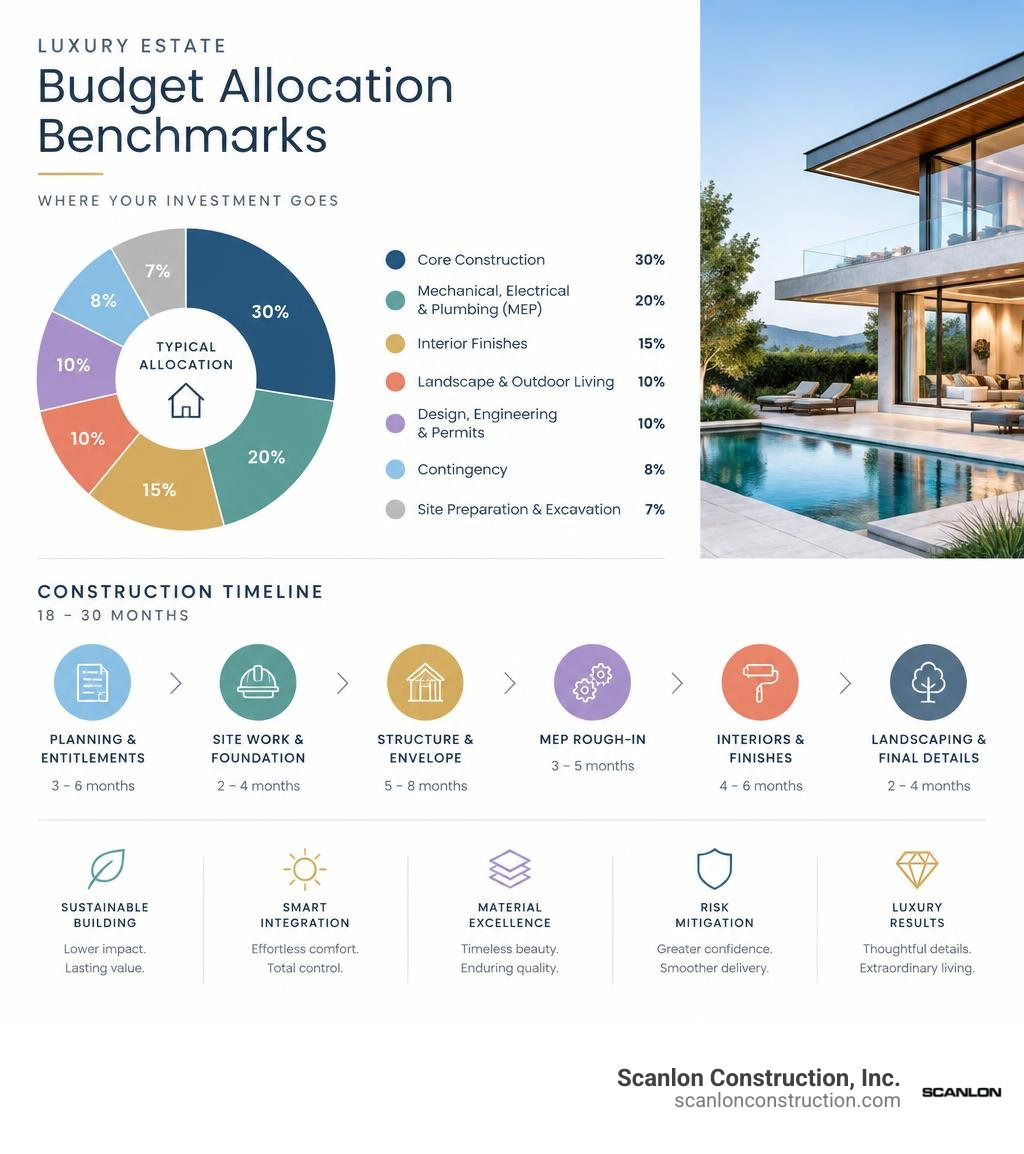
Realistic Construction Costs and Timeline Phases (18–30 Months)
Prospective owners must approach their build with a clear timeline and budget framework. Custom estate construction is a multi-year commitment, typically requiring 18 to 30 months depending on municipal zoning, entitlement reviews, site topography, and overall scale.
When planning, review everything you need to know about building a modern luxury home in Los Angeles to understand the intricate entitlement and inspection hurdles common in strict jurisdictions.
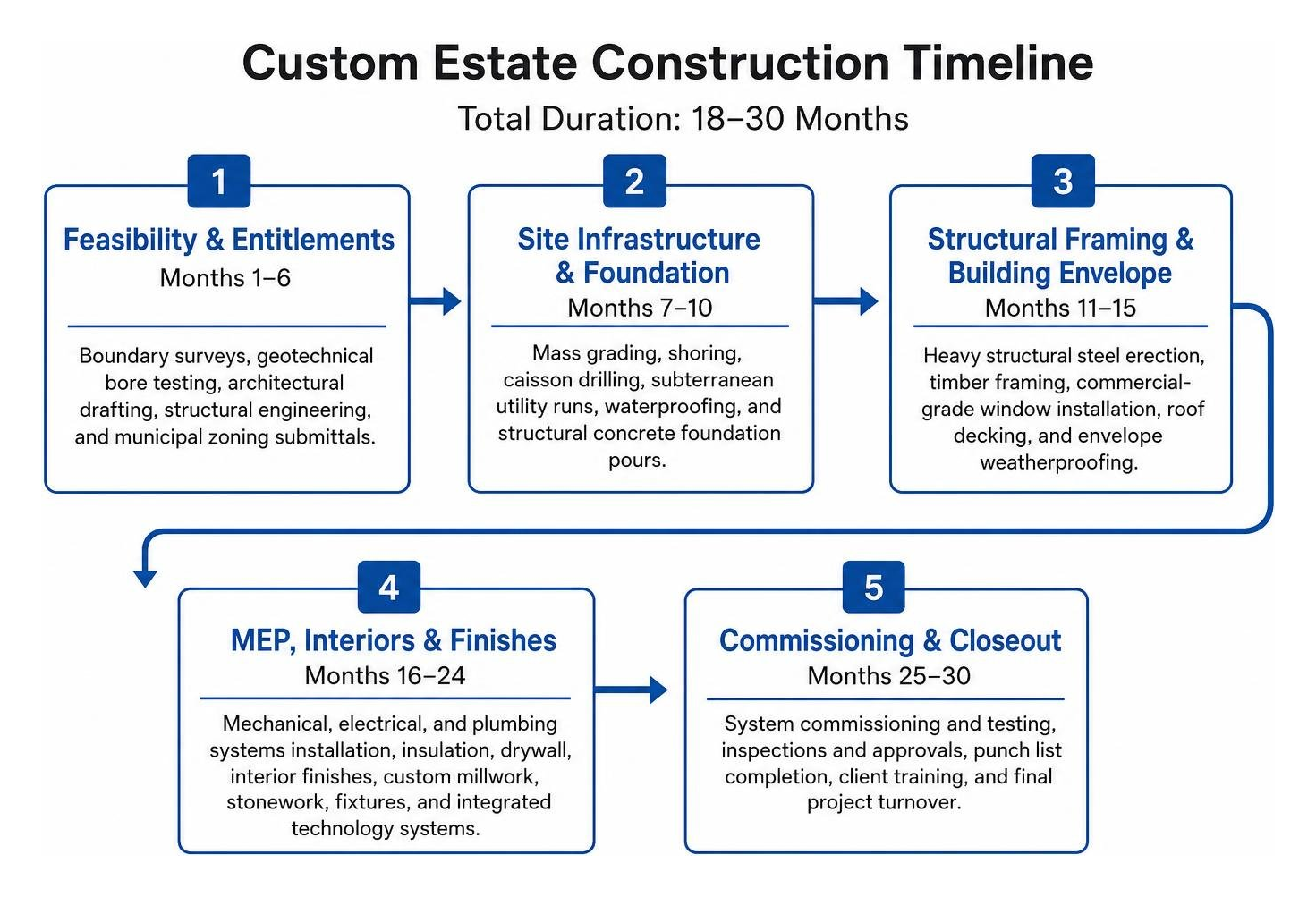
The critical path typically breaks down into five defined phases:
- Feasibility & Entitlements (Months 1–6): Boundary surveys, geotechnical bore testing, architectural drafting, structural engineering, and municipal zoning submittals.
- Site Infrastructure & Foundation (Months 7–10): Mass grading, shoring, caisson drilling, subterranean utility runs, waterproofing, and structural concrete foundation pours.
- Structural Framing & Building Envelope (Months 11–15): Heavy structural steel erection, timber framing, commercial-grade window installation, roof decking, and envelope weatherproofing.
- Rough Mechanicals & Advanced Drywall (Months 16–21): MEP rough-ins, low-voltage wiring, acoustic insulation, spray foam thermal insulation, and Level 5 architectural drywall finishing.
- Artisan Finishes & Commissioning (Months 22–30): Custom cabinetry, stone slab fabrication, hardwood flooring, fixtures, landscape hardscaping, pool construction, and complete smart-system calibration.
Essential Credentials to Verify in Builders of Luxury Homes
Not every licensed contractor possesses the financial stability, trade relationships, or managerial sophistication to bring a multi-million-dollar blueprint to life.
Before signing an agreement, verify these essential builder credentials:
- Active Class B General Building License in good standing with zero disciplinary citations or unresolved mechanic’s liens.
- Comprehensive Risk Insurance Coverage, including high-limit Commercial General Liability, Builder’s Risk policies, and dedicated Workers’ Compensation.
- Deep Portfolio of Completed Estates that share similar architectural complexity, structural engineering challenges, and square footage.
- Transparent Accounting Software providing open-book financial reporting, lien waiver verification for all sub-trades, and detailed job-cost tracking.
- Established Trade Partner Network with master artisans, architectural metal fabricators, and master plumbers/electricians with decades of collaboration.
Take the time to evaluate choosing the right high-end residential builders for complex custom estates by visiting their active job sites to review organization, safety, cleanliness, and craftsmanship first-hand.
Frequently Asked Questions About Custom Luxury Construction
How much does it cost per square foot to build a custom luxury home?
In major metropolitan and coastal markets, high-end custom home construction typically starts between $500 and $1,000+ per square foot, with ultra-luxury estates featuring complex engineering, imported materials, and specialty amenities exceeding $1,500+ per square foot. Key drivers include site topography, foundation complexity, framing styles (structural steel vs. timber), glazing packages, and bespoke interior finishes.
How long does the custom luxury home building process take?
A ground-up custom luxury residence generally requires 18 to 30 months from initial architectural planning to final occupancy. The timeline is split between pre-construction/permitting (6 to 12 months, depending on local municipal backlogs) and physical construction (12 to 24 months, depending on estate scale and architectural detail).
What is the difference between a general contractor and a luxury design-build firm?
A traditional general contractor bids on completed drawings and builds according to fixed specifications, often leading to change orders when field conditions clash with architectural intent. A luxury design-build firm coordinates architecture, structural engineering, interior detailing, and physical construction under a single unified management contract. This integrated model provides tighter cost control, prevents schedule delays, and maintains architectural integrity from day one.
Conclusion
Building a custom estate is the realization of a life’s vision—a legacy space designed to inspire, comfort, and endure for generations. Achieving this balance of aesthetic elegance and structural longevity requires more than ambition; it demands an experienced building partner with the technical skill to execute complex engineering and the dedication to deliver uncompromising craftsmanship.
At Scanlon Construction, Inc., we bring more than 30 years of building mastery, green construction innovation, and deep architectural collaboration to upscale residential estates across Southern California. When you are ready to translate ambitious blueprints into a timeless living environment, partner with premier luxury estate builders who understand the art and science of high-end custom residential construction.