

Vetting Luxury Builders for Your Next Custom Home Overhaul
Find a Luxury Remodeler With the Systems to Deliver
When comparing high end remodeling companies near me, look beyond attractive photos. Choose a licensed, fully insured firm with a portfolio of projects similar to yours, a clear design and permitting process, detailed written scopes, and proven experience with Southern California conditions and local approvals.
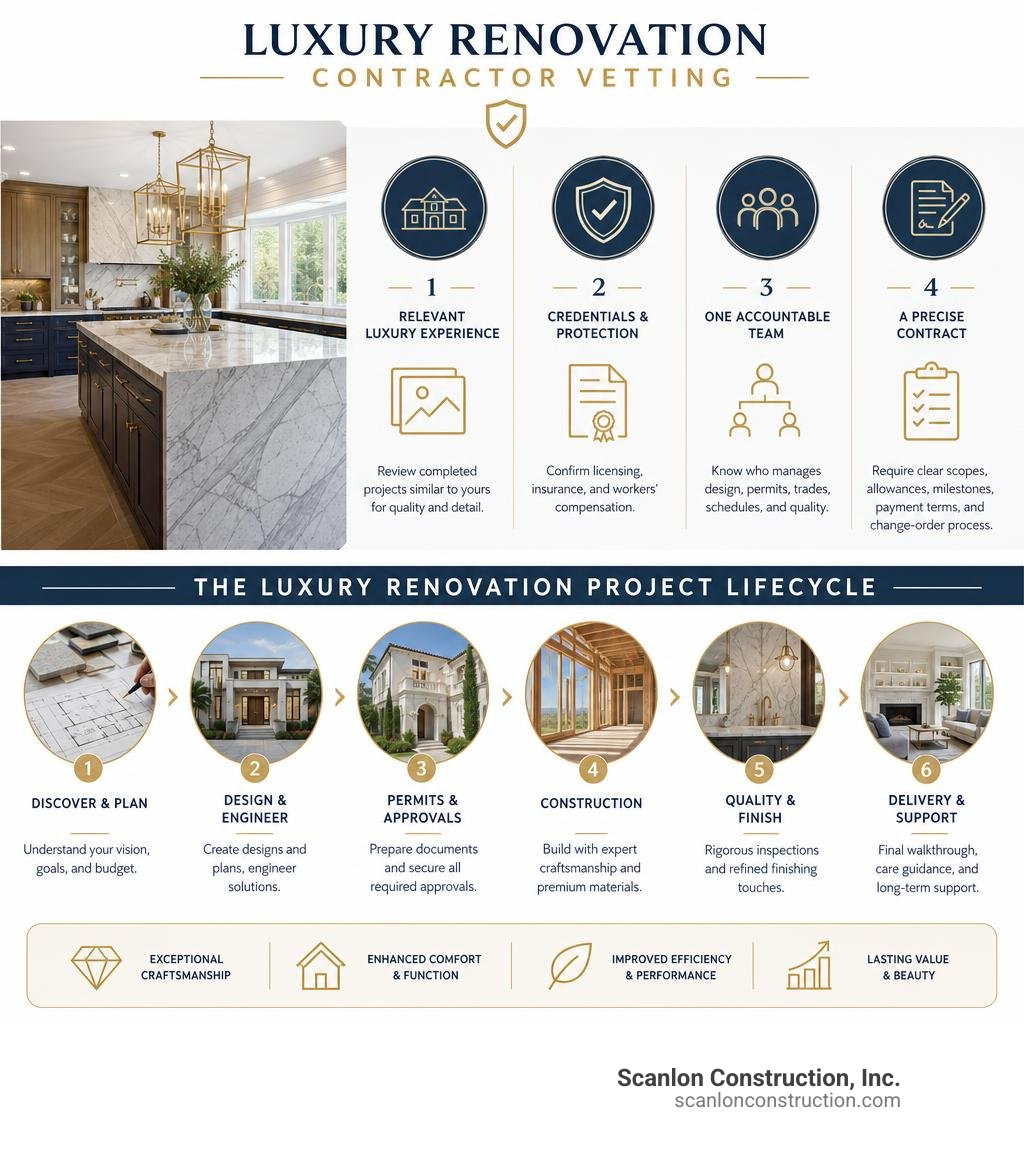
Before you schedule consultations, verify these basics:
- Relevant luxury experience: Ask to see completed kitchens, baths, additions, or whole-home overhauls with comparable architectural detail and finish quality.
- Credentials and protection: Confirm licensing, liability coverage, workers’ compensation, and specialized remodeling credentials where applicable.
- One accountable team: Understand who handles design coordination, permits, subcontractors, schedule updates, and quality checks.
- A precise contract: Require named materials, allowances, milestones, payment terms, warranty coverage, and a signed change-order process.
A major custom home overhaul is not simply a larger version of a standard renovation. It often involves structural engineering, custom millwork, natural stone, high-performance systems, permit reviews, and long-lead materials. The right builder helps resolve these details before demolition, protecting both the design intent and the investment.
For affluent homeowners, the payoff is more than visual impact: a well-planned luxury remodel can improve daily function, energy performance, comfort, and long-term property value.
How to Evaluate High End Remodeling Companies Near Me
Searching for upscale building partners requires evaluating how a company operates behind the scenes. Elite residential overhauls involve intricate logistics, artisan trades, and rigorous building science. Standard general contractors often juggle basic trade crews and off-the-shelf components, while luxury remodelers run full-scale white-glove operations tailored to discerning architectural specifications.
When evaluating builders, examine their baseline operating procedures. A luxury firm assigns dedicated on-site project superintendents, enforces tight site-cleanliness standards, and coordinates specialty artisans—from master stone fabricators to bespoke cabinetmakers. They handle the administrative burden of zoning approvals, historical preservation boards, and structural engineering reviews without handing the stress off to you.
| Feature / Standard | Standard General Contractor | Luxury Remodeling Firm |
|---|---|---|
| Project Management | Off-site oversight; periodic check-ins | Dedicated on-site superintendent; daily client logs |
| Material Sourcing | Stock lines; regional big-box suppliers | Bespoke architectural millwork; quarried slab stone |
| Trade Specialists | Generalist trade crews | Certified artisan subs (finish carpenters, master masons) |
| Pre-Construction | Rough estimates; demo before procurement | Full 3D modeling, engineering checks, advance warehousing |
| Cleanliness & Protection | Basic drop cloths | Negative air scrubbers, zipper barriers, floor protection |
| Warranties & Service | Standard 1-year statutory coverage | 1- to 3-year comprehensive warranties; post-build checkups |
Choosing between these two models comes down to risk management. Accepting the lowest bid on an upscale estate carries substantial hazards: poor material execution, structural delays, code violations, or unexpected mid-project change orders. True luxury remodeling firms provide transparent, comprehensive pricing that accounts for every technical nuance upfront.
Verifying Credentials and Certifications of High End Remodeling Companies Near Me
Elite remodeling credentials reflect a contractor’s commitment to industry education, construction ethics, and building science. When vetting candidates, ask about advanced designations such as the Master Certified Remodeler (MCR) or Master Certified Kitchen & Bath Remodeler (MCKBR). Fewer than 2% of contractors nationwide hold both designations, which signal advanced expertise in complex structural alterations, waterproofing, and building envelope performance.
Look for formal memberships with recognized trade authorities, including the National Association of the Remodeling Industry (NARI) and the National Association of Home Builders (NAHB). In addition to third-party credentials, confirm essential legal protections:
- Active State Contractor Licenses: Check your state’s licensing board for clean disciplinary records and verified classifications.
- Comprehensive General Liability & Workers’ Comp: Ensure coverage limits match the value of your estate, protecting you from on-site liabilities.
- Local Municipality Knowledge: Verify direct experience working with regional building departments, environmental regulations, and architectural review boards (HOAs).
Our team at Scanlon Construction combines more than 30 years of building heritage with green building certifications, providing tailored residential remodeling services that harmonize luxury aesthetics with modern efficiency across Southern California.
Assessing Portfolios and Architectural Staging for High End Remodeling Companies Near Me
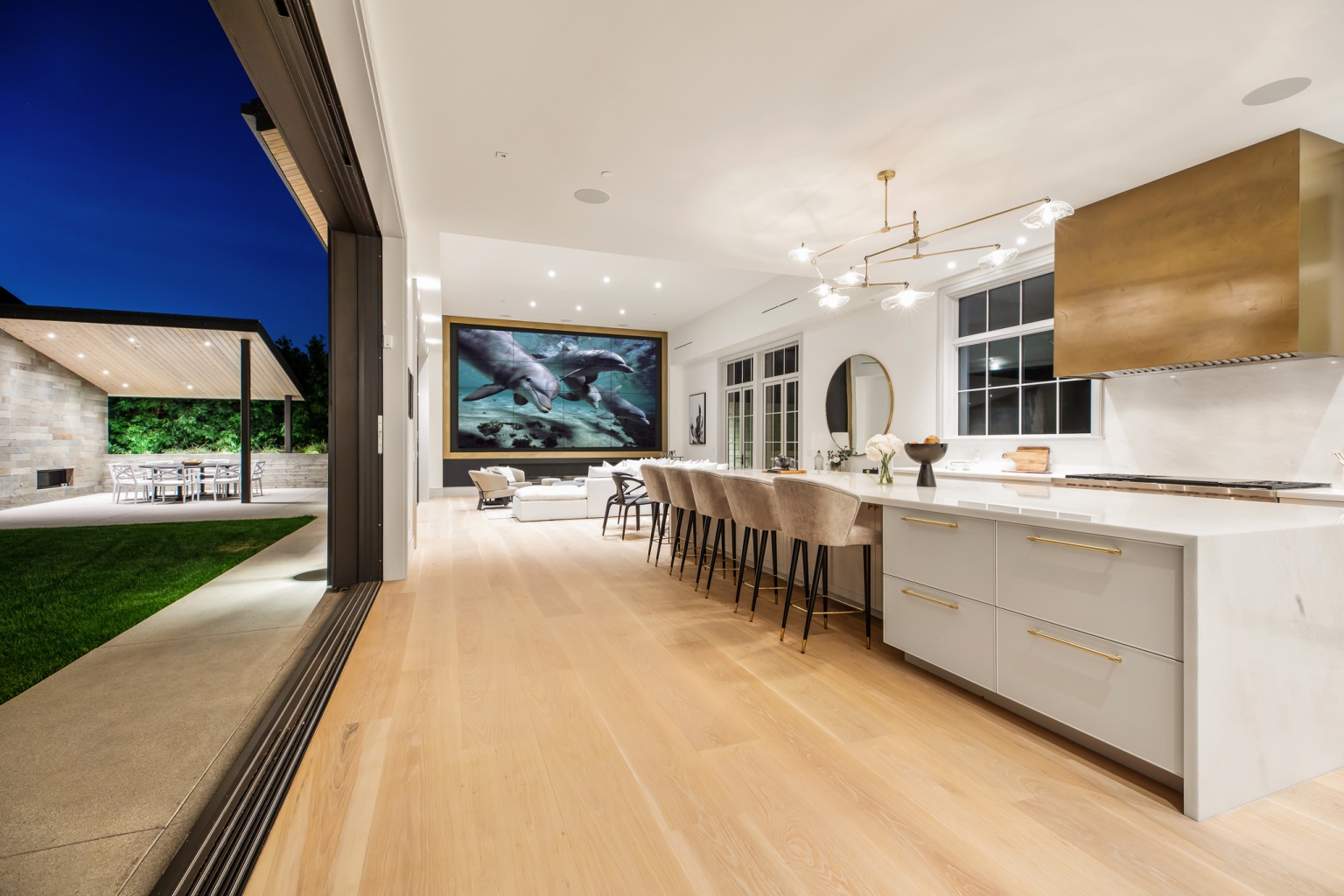
A builder’s project gallery reveals their standard of execution. High-end remodelers present cohesive project narratives and high-resolution architectural photography rather than quick smartphone snapshots with harsh lighting.
Evaluate their imagery for genuine craftsmanship details:
- Architectural Storytelling: Look for professional architectural photography that highlights natural lighting, material textures, and spatial harmony. Architectural photographers charge between $1,000 and $2,000 per day to capture these nuances, whereas standard real estate photography ($300 to $500) relies on wide-angle lenses that distort scale.
- Craftsmanship Vignettes: Look for close-up shots of book-matched marble slabs, mitered waterfall countertop edges, seamless custom millwork joints, and flush-mount mechanical grilles.
- Staging Integrity: Legitimate luxury galleries feature real, physically staged environments designed with authentic furnishings—not computer-generated or AI-staged overlays that can mask flawed trim work or poor alignment.
Review our portfolio of completed luxury projects to see how structural planning, custom stonework, and fine architectural finishes come together in practice.
Design-Build vs. Traditional Contracting for Luxury Renovations

Homeowners undertaking high-end residential renovations typically choose between two project delivery models: traditional Design-Bid-Build or unified Design-Build.
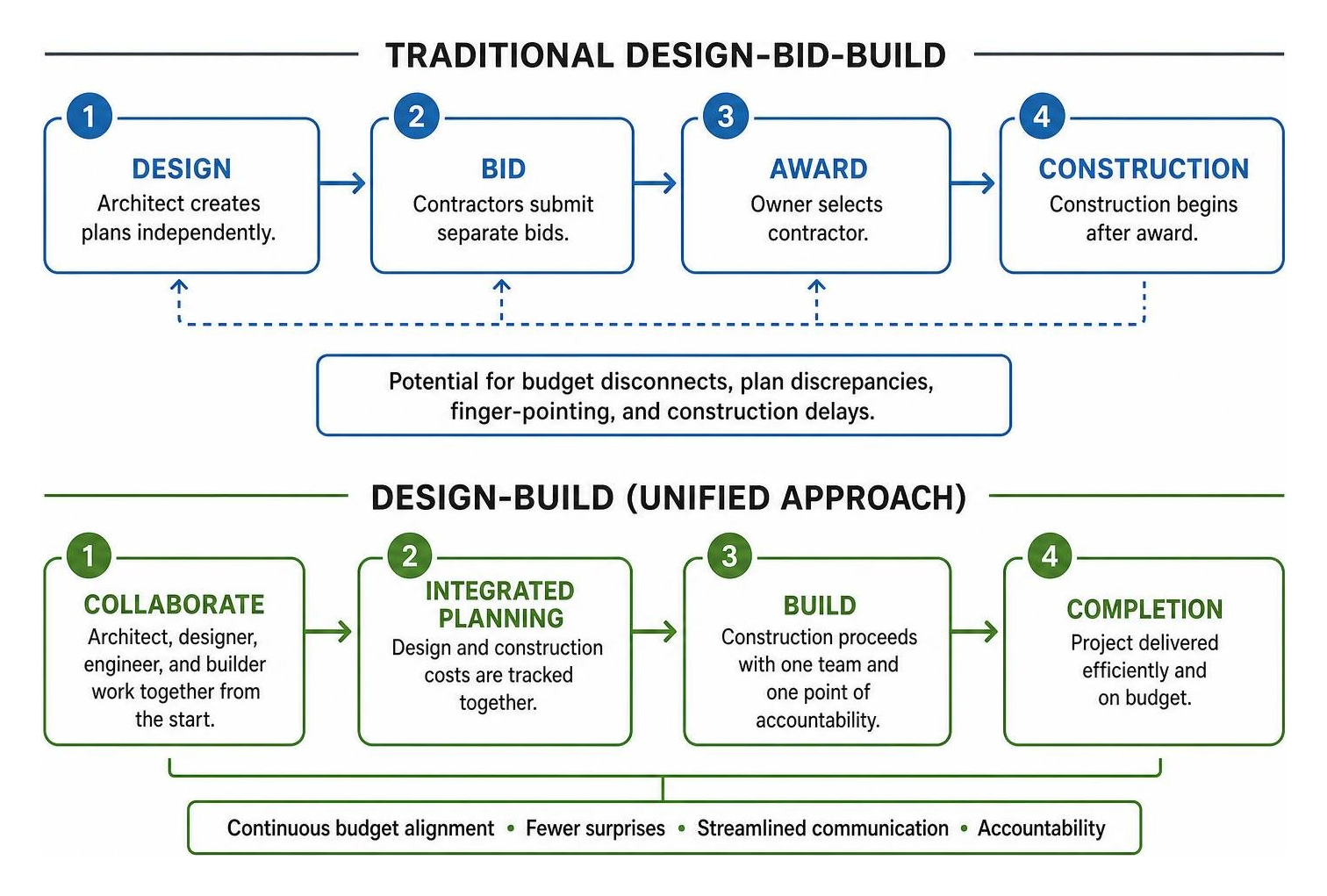
In the traditional model, an architect designs plans independently before contractors submit bids. This separation can lead to budget disconnects, finger-pointing over plan discrepancies, and lengthy construction delays.
The Design-Build approach unifies architectural planning, interior design, engineering, and construction under a single point of accountability:
- Continuous Budget Alignment: Construction costs are tracked alongside design development, avoiding redesigns when initial estimates exceed target budgets.
- Pre-Construction Procurement: All specialty materials—from imported European fixtures to custom steel-framed doors—are ordered and warehoused prior to demolition, avoiding mid-project downtime.
- Cohesive Communication: Architects, structural engineers, and site superintendents collaborate directly, resolving field conditions quickly.
- Site Protection Protocols: Design-build teams prioritize your home environment using negative air scrubbers, sealed zipper dust barriers, and rigid floor protection to isolate living quarters from active workspaces.
Structural Engineering, Permitting, and Local Code Compliance
Luxury remodeling often involves complex structural modifications: removing load-bearing walls for expansive open layouts, vaulting ceilings, installing multi-slide pocket doors, or building cantilevers. These architectural features require precise structural calculations and close coordination with municipal authorities.
A seasoned luxury builder handles this entire permitting and engineering pipeline:
- Feasibility & Structural Analysis: Coordinating with structural and geotechnical engineers to evaluate foundations, seismic loads, and framing requirements.
- Municipal Permitting: Submitting plan sets, Title 24 energy calculations, and environmental documentation to local building departments.
- Zoning & Historical Reviews: Navigating neighborhood overlays, hillside building ordinances, and strict Architectural Review Board requirements.
- Multi-Stage Rough Inspections: Managing required city inspections—including foundation, framing, plumbing, electrical, and mechanical rough-ins—before closing up walls.
Craftsmanship Warranties and Change Order Protocols
Unforeseen issues—such as dated electrical wiring, subfloor moisture, or framing out of plumb—most often emerge during the demolition phase of older homes. How a builder manages these discoveries protects your budget and your peace of mind.
Professional contractors use structured protocols to handle project changes:
- Fixed-Price Work Scopes: Detailed line items outlining brand names, model numbers, finish allowances, and installation specifications.
- Formal Change Orders: A strict policy where no out-of-scope work proceeds without written authorization, explicit cost estimates, and clear timeline adjustments.
- Transparent Cloud Portals: Using modern construction management software to provide real-time updates, daily field logs, shared milestone schedules, and budget tracking.
- Multi-Year Warranties: Backing finished craftsmanship with written 1- to 3-year warranties that cover labor and material bonding beyond basic statutory minimums.
Anticipated Investment and Timelines for Upscale Remodels
Understanding real-world costs helps establish realistic investment parameters. While national averages place standard kitchen remodels between $28,696 and $90,397, and basic bathroom upgrades between $5,809 and $59,433, custom luxury projects require a higher investment to cover premium materials and specialized trades.
High-end kitchen remodels typically range from $100,000 to $300,000+, depending on structural wall removals, bespoke cabinetry, slab stone countertops, and professional-grade appliance suites. Comprehensive primary bathroom transformations frequently span $30,000 to $90,000+, incorporating radiant floor heating, custom steam showers, standalone soaking tubs, and book-matched slab installations.
For single-level or whole-home custom transformations, investments routinely range from $350,000 to over $1,000,000, with lead times and construction schedules reflecting that scale:
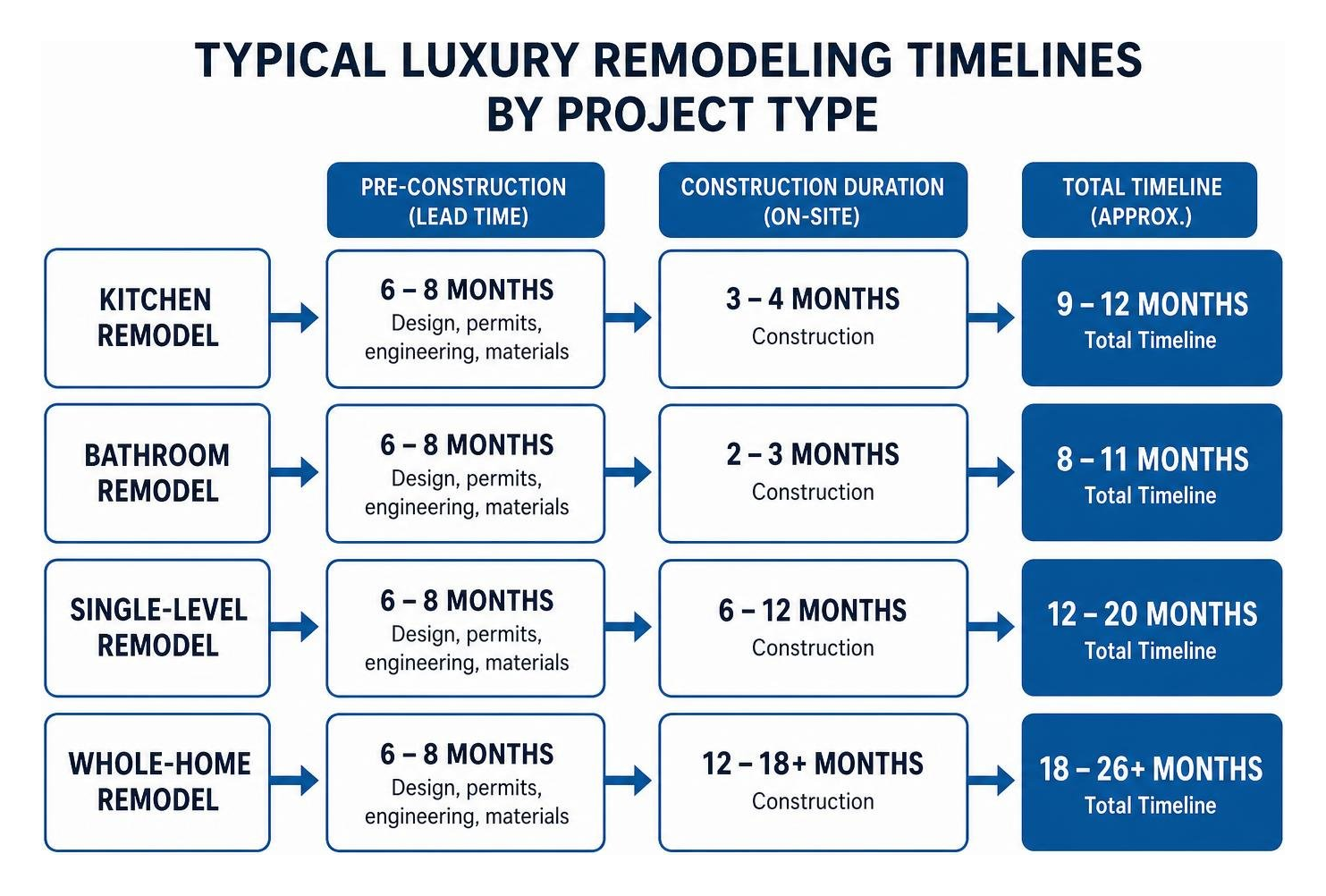
Pre-construction lead times typically require 6 to 8 months to finalize 3D architectural plans, secure municipal permits, coordinate engineer stamps, and warehouse long-lead materials before site work begins.
Sustainable Building and High-Performance Finishes
True luxury balances visual refinement with environmental stewardship and energy performance. Integrating green building practices during a custom overhaul creates a healthier, quieter, and more resilient home.
High-performance renovations often incorporate:
- Advanced Building Envelopes: Continuous thermal insulation, airtight air barriers, and high-performance multi-pane windows to stabilize indoor temperatures and lower HVAC loads.
- Healthy Indoor Air Quality: Low-VOC paints, solvent-free adhesives, and dedicated Energy Recovery Ventilator (ERV) systems that supply fresh, filtered air throughout the home.
- Energy-Efficient Systems: High-efficiency heat pump HVAC units, smart architectural lighting panels, and high-efficiency plumbing fixtures that conserve resources without sacrificing water pressure.
- Architectural Longevity: Sourcing durable, ethically harvested materials that age gracefully, minimizing lifecycle maintenance costs.
Our deep dedication to expert craftsmanship and builder heritage guides our approach to luxury construction, ensuring your renovated estate remains efficient, comfortable, and valuable for decades to come.
Frequently Asked Questions About Luxury Home Renovations
What distinguishes a luxury remodeling firm from a standard general contractor?
Luxury remodeling firms provide an all-inclusive, design-driven experience with dedicated on-site superintendents, certified trade specialists, and white-glove project management. They specialize in complex architectural alterations, bespoke millwork, imported finishes, and strict jobsite cleanliness standards that standard general contractors are rarely equipped to manage.
How long does a whole-home luxury renovation take to complete?
A whole-home luxury renovation generally takes between 6 and 14 months of physical construction, following a 6- to 8-month pre-construction phase. Overall timelines depend on structural modifications, permitting turnaround, the home’s total square footage, and the lead times for custom architectural materials.
Can homeowners remain in the residence during a major overhaul?
While homeowners can sometimes remain on-site during single-room or isolated bathroom updates, temporary off-site living arrangements are strongly recommended for major kitchen overhauls, additions, or whole-home renovations. Vacating the property allows trades to work more efficiently, prevents daily living disruptions, and protects family members from noise, dust, and utility shutoffs.
Conclusion
Transforming an estate through a major custom overhaul is an exciting journey that requires a skilled, communicative, and detail-oriented building partner. By verifying certifications, reviewing architectural portfolios, insisting on transparent contracts, and choosing an integrated design-build approach, you protect your investment and ensure an enjoyable renovation experience.
Scanlon Construction brings more than three decades of experience to luxury residential transformations throughout Los Angeles. We combine sustainable building science with artisan craftsmanship to create tailored, timeless living spaces. When you are ready to explore your home’s possibilities, bring your architectural vision to life with custom luxury construction or get in touch with our building team to schedule your initial design consultation.