
Smart Steps to Vetting Wildfire Rebuild Contractors Across Los Angeles
How to Choose a Qualified Fire Rebuild Contractor in Los Angeles
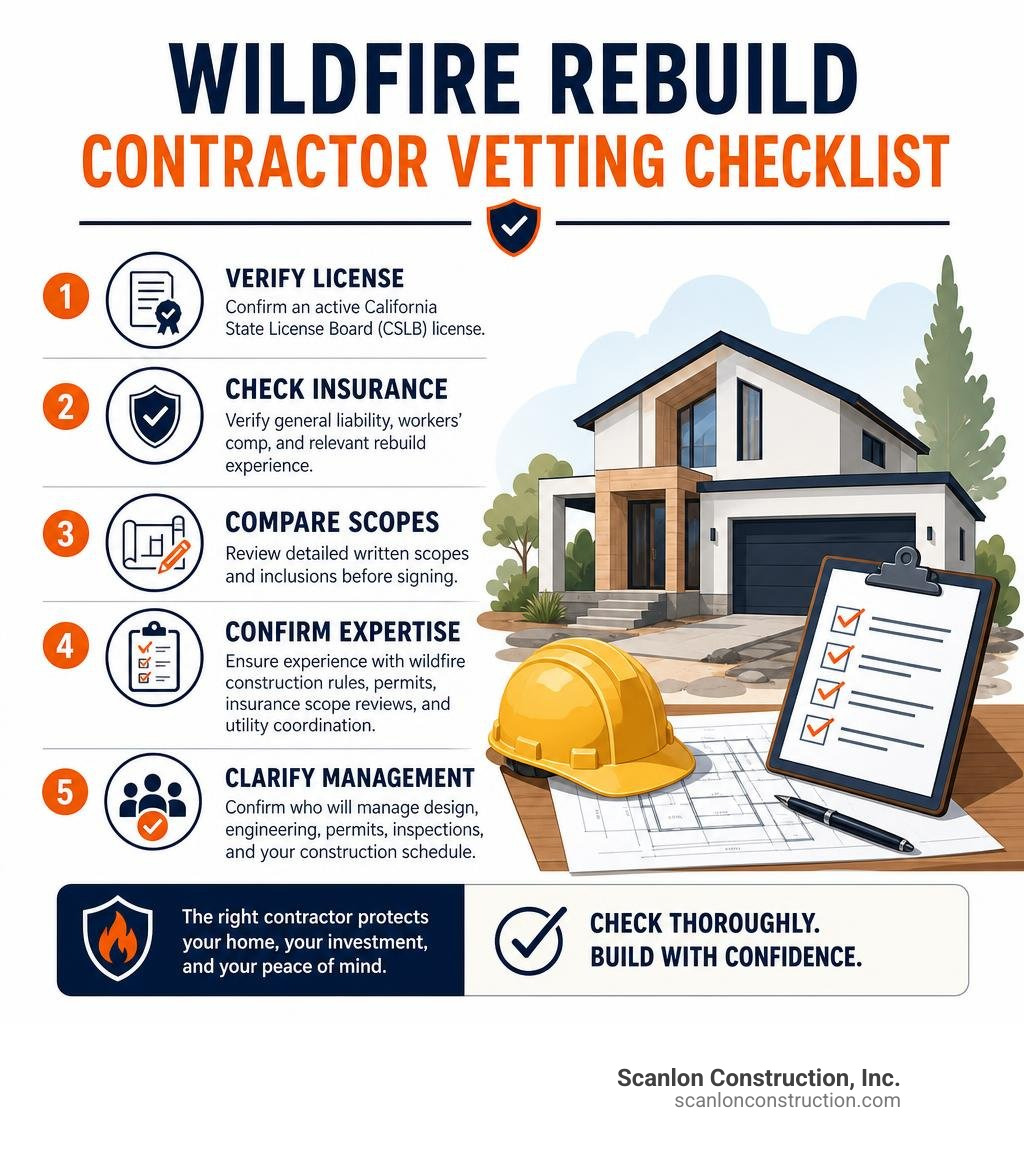
To find the right fire rebuild contractor Los Angeles homeowners should start with three checks: confirm an active California State License Board (CSLB) license, verify insurance and relevant rebuild experience, and compare detailed written scopes before signing a contract. The contractor should understand wildfire construction rules, current Los Angeles permitting paths, insurance scope reviews, and utility coordination – not just general remodeling.
A strong candidate can clearly explain:
- Whether your home needs total-loss reconstruction or deep smoke and soot remediation.
- How current fire, energy, structural, and hillside codes may affect the insurance settlement.
- Which expedited pathway may apply, including like-for-like rebuilding options.
- Who will manage design, engineering, permits, inspections, and the construction schedule.
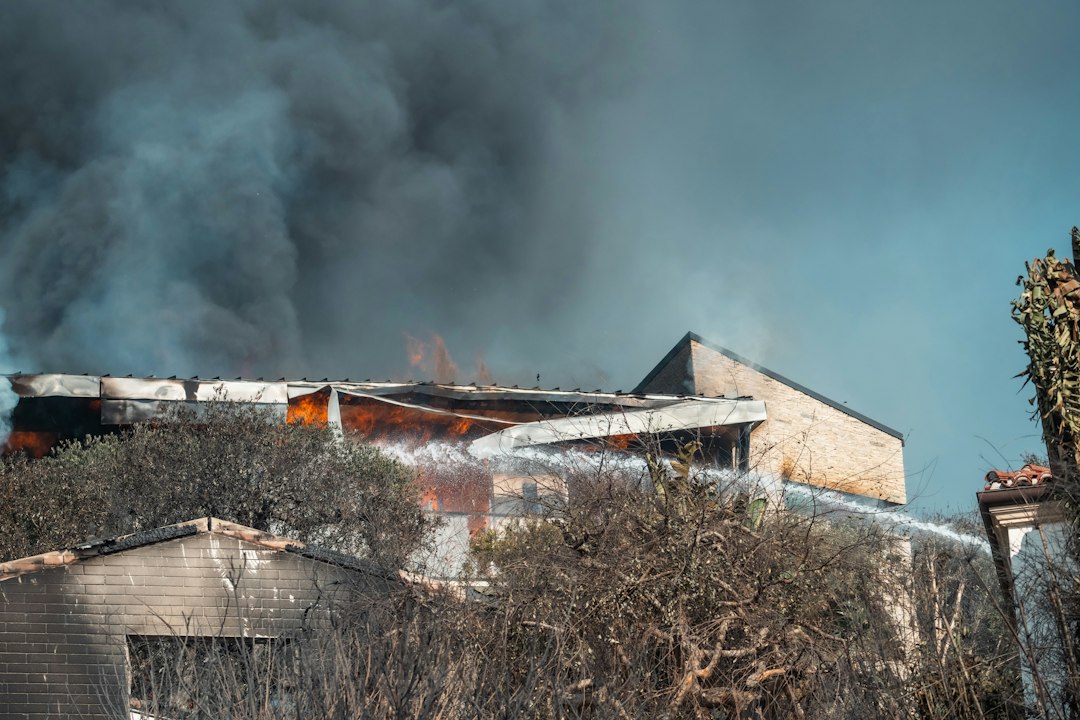
After a wildfire, the fastest-looking bid is not always the safest choice. Rebuilding a custom home involves far more than replacing what burned. It can require new foundations, fire-resistant exterior assemblies, upgraded utilities, and careful coordination with LADBS and other agencies. This guide explains how to vet qualified professionals and make informed decisions before work begins.
Assessing Your Property: Total-Loss Reconstruction vs. Smoke Damage Remediation
When assessing fire damage across a residential parcel, the scope of work splits into two distinct paths: ground-up structural reconstruction or deep structural decontamination and repair. Confusing the two or treating deep smoke damage like a cosmetic repaint leads to long-term structural failures, lingering air quality hazards, and stalled insurance claims.
| Rebuild Factor | Total-Loss Reconstruction | Smoke & Soot Remediation |
|---|---|---|
| Primary Scope | Demolition, structural engineering, ground-up rebuild | Thermal deodorization, material removal, encapsulation |
| Foundation Status | Full geotechnical test, core sampling, typical replacement | Visual inspection, wash, minimal structural intervention |
| Mechanical Systems | Complete new electrical, plumbing, HVAC, and fire sprinklers | Full ductwork replacement, coil cleaning, unit overhaul |
| Building Code Path | Full compliance with current Wildland-Urban Interface (WUI) | Repair-in-place building standards, finish matching |
| Permit Clearances | Structural, grading, coastal/hillside, utility sign-offs | Trade-specific MEP permits, interior alteration permits |
Total-Loss Rebuilds and Structural Foundation Assessments
A total loss involves more than clearing away charred framing. Extreme heat from intense wildfires alters the physical properties of building materials.
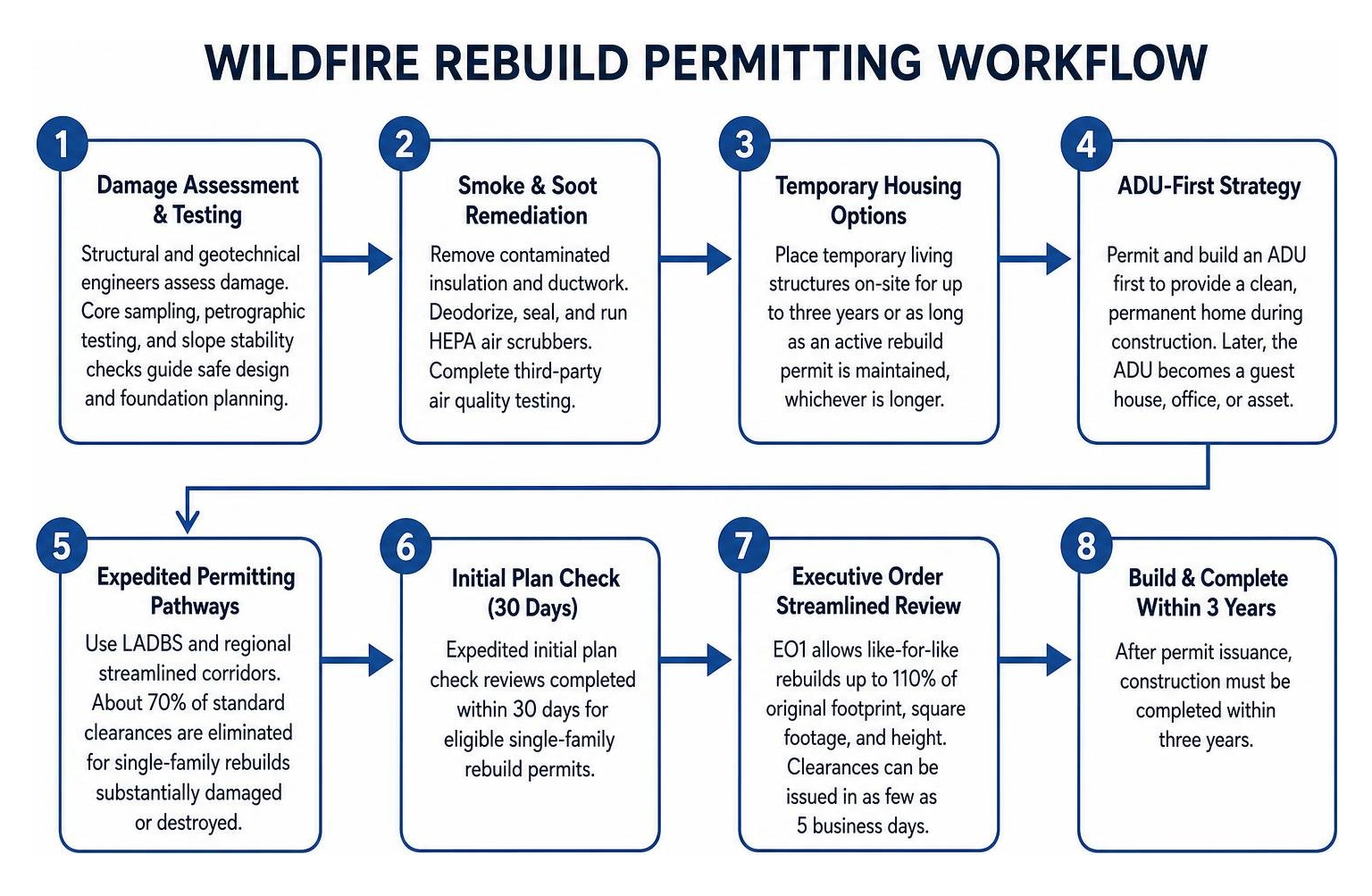
Concrete foundations exposed to high-heat spalling lose structural capacity as internal moisture turns to steam and fractures the matrix. We bring in licensed structural engineers to conduct core sampling and petrographic testing. In hillside terrain, geotechnical engineers must test slope stability and check for soil slippage before re-anchoring new foundations to bedrock with seismic tie-downs.
Deep Smoke and Soot Remediation Beyond Surface Repairs
If your home’s envelope survived the flames, toxic soot, volatile organic compounds (VOCs), and micron-sized particulate matter still migrate into enclosed assemblies.
Surface wiping and rolling fresh paint over soot does not resolve the issue. Smoke odors settle deep into open wall cavities, crawlspaces, and porous framing. Comprehensive remediation requires:
- Removing and replacing all blown or batt attic insulation.
- Completely removing contaminated HVAC ductwork.
- Performing thermal fogging or ozone deodorization on exposed structural lumber.
- Applying specialty odor-blocking sealants to raw framing before hanging new drywall.
- Running industrial HEPA air scrubbers followed by independent third-party air quality testing.
Temporary Housing Options and Building an ADU First
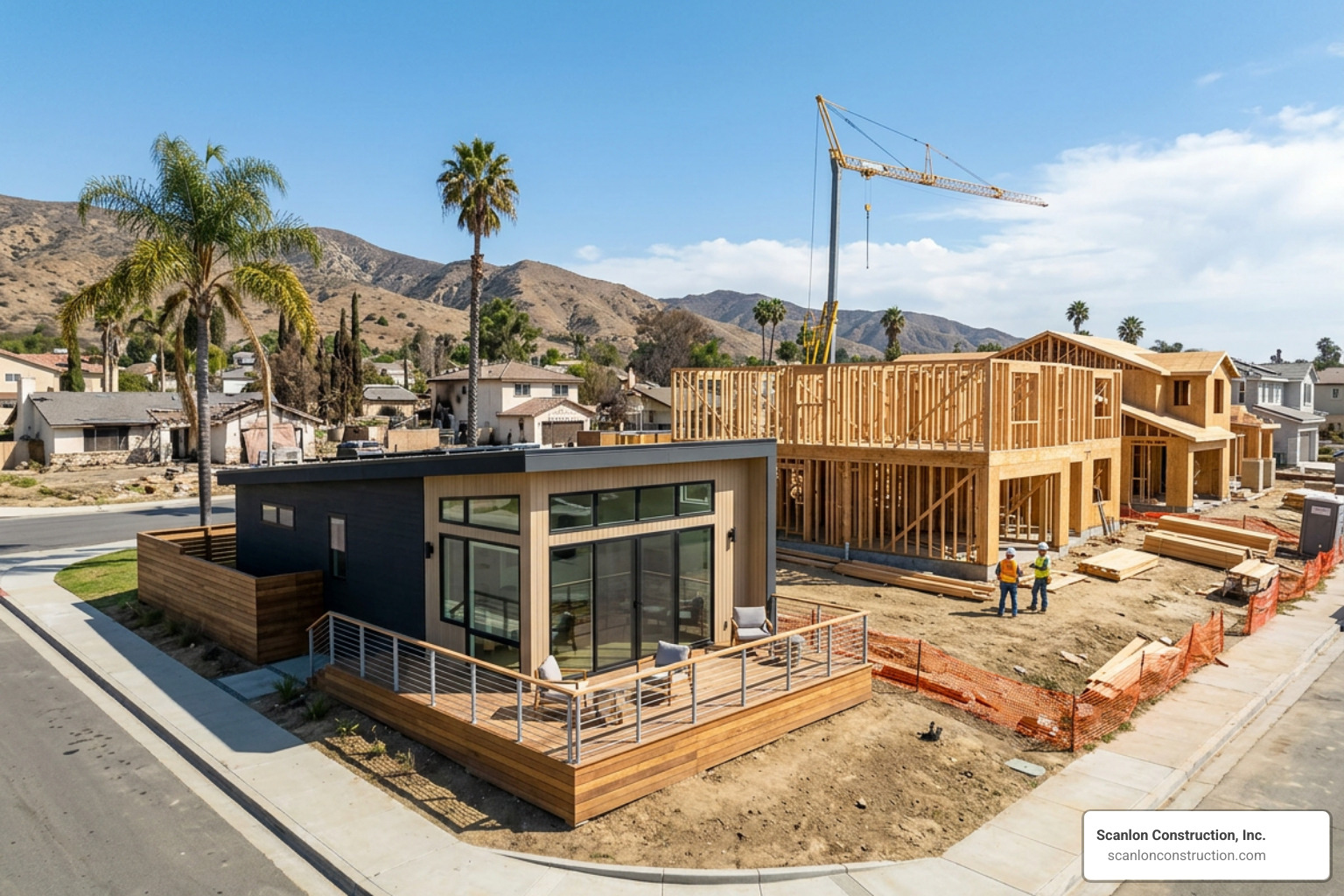
Displaced homeowners in Los Angeles can place temporary living structures on their parcel while the main house is designed and built. The city allows temporary structures—such as RVs, trailers, manufactured units, and mobile homes—to remain on-site for up to three years or as long as an active rebuild permit is maintained, whichever is longer.
Another strategic pathway is permitting and building an Accessory Dwelling Unit (ADU) first. Building a permanent ADU gives your family a clean, modern residence on your own land during primary construction. Once the main luxury home is completed, that ADU converts immediately into a guest house, home office, or long-term asset.
Navigating City Regulations, Executive Orders, and Expedited Permitting Pathways
To speed post-disaster recovery, the Los Angeles Department of Building and Safety (LADBS) and regional agencies have established streamlined rebuilding corridors. For single-family rebuild permits, the city eliminated approximately 70% of standard departmental clearances. Structures substantially damaged or destroyed by recent events receive expedited initial plan check reviews completed within 30 days.
Once your building permit is issued, city guidelines require construction to wrap up within three years. From decades of custom builds and our Woolsey Fire home repair and renovation experience, we help homeowners navigate these expedited avenues without sacrificing architectural craftsmanship.
Streamlined Review Under Executive Orders EO1 and EO8
Two major directives shape how quickly plans move through LADBS:
- Executive Order 1 (EO1): Tailored for “like-for-like” rebuilds. It allows you to rebuild your original home layout up to 110% of the previous footprint, square footage, and height. Clearances under EO1 can be issued in as few as 5 business days, bypassing lengthy zoning re-evaluations.
- Executive Order 8 (EO8): Designed for homeowners who want to reimagine their estate beyond the 110% footprint. While EO8 accommodates custom architectural expansions and updated floorplans, plans must satisfy modern base zoning setbacks, height envelopes, and fire department access standards while still benefiting from waived administrative clearances.
AI Pre-Plan Check Tools and Self-Certification Programs
LADBS integrates automated pre-screening tools like the Archistar AI platform—affectionately known as “E-Check” (no relation to the grocery aisle). This software scans digital blueprints against municipal zoning rules, setback constraints, and fire corridors before formal plan submission, highlighting issues instantly.
Paired with the city’s Architect Self-Certification pilot program, qualified design professionals can self-certify compliant elements to bypass weeks of back-and-forth review cycles.
Hillside, Coastal, and Environmental Clearances
Rebuilding along mountain ridgelines or coastal bluffs introduces specialized site criteria. Hillside parcels often require baseline grading reviews, structural shoring designs, and brush clearance certifications.
However, regulatory relief has removed common bottlenecks: less than 5% of single-family rebuilds in zones like Pacific Palisades require full Low Impact Development (LID) stormwater reviews, and many coastal parcels qualify for disaster-repair exemptions when staying within permitted footprints.
How to Vet and Select a Qualified Fire Rebuild Contractor in Los Angeles
Disaster zones often attract unvetted, out-of-state operators promising quick turnarounds on handshakes. Selecting a reputable partner ensures your project stays on schedule, meets building codes, and delivers lasting quality. For complete accountability, our services bring architectural design, structural engineering, and luxury construction under a single, unified contract.
Verifying CSLB Licenses and Fire Rebuild Contractor Los Angeles Credentials
Never rely on a printed business card alone. Protect your home and investment by verifying all contractor credentials through official channels:
- Check the CSLB Database: Ensure the contractor holds an active Class B General Building Contractor license in good standing with zero unresolved disciplinary actions on the California State License Board (CSLB) portal.
- Workers’ Compensation & Liability: Demand proof of active workers’ compensation coverage for all crew members and comprehensive general liability insurance policies naming you as an additional insured.
- Reference Verification: Ask for verifiable addresses of completed custom projects across Los Angeles, particularly in hillside and wildfire rebuild zones.
- City-Curated Lists: Cross-reference prospective builders with municipal recovery databases and local trade networks.
Wildfire Construction Standards and Fire-Resistant Materials
Under California’s Chapter 7A Wildland-Urban Interface (WUI) building codes, reconstructed homes must be engineered to resist embers, radiant heat, and direct flames.
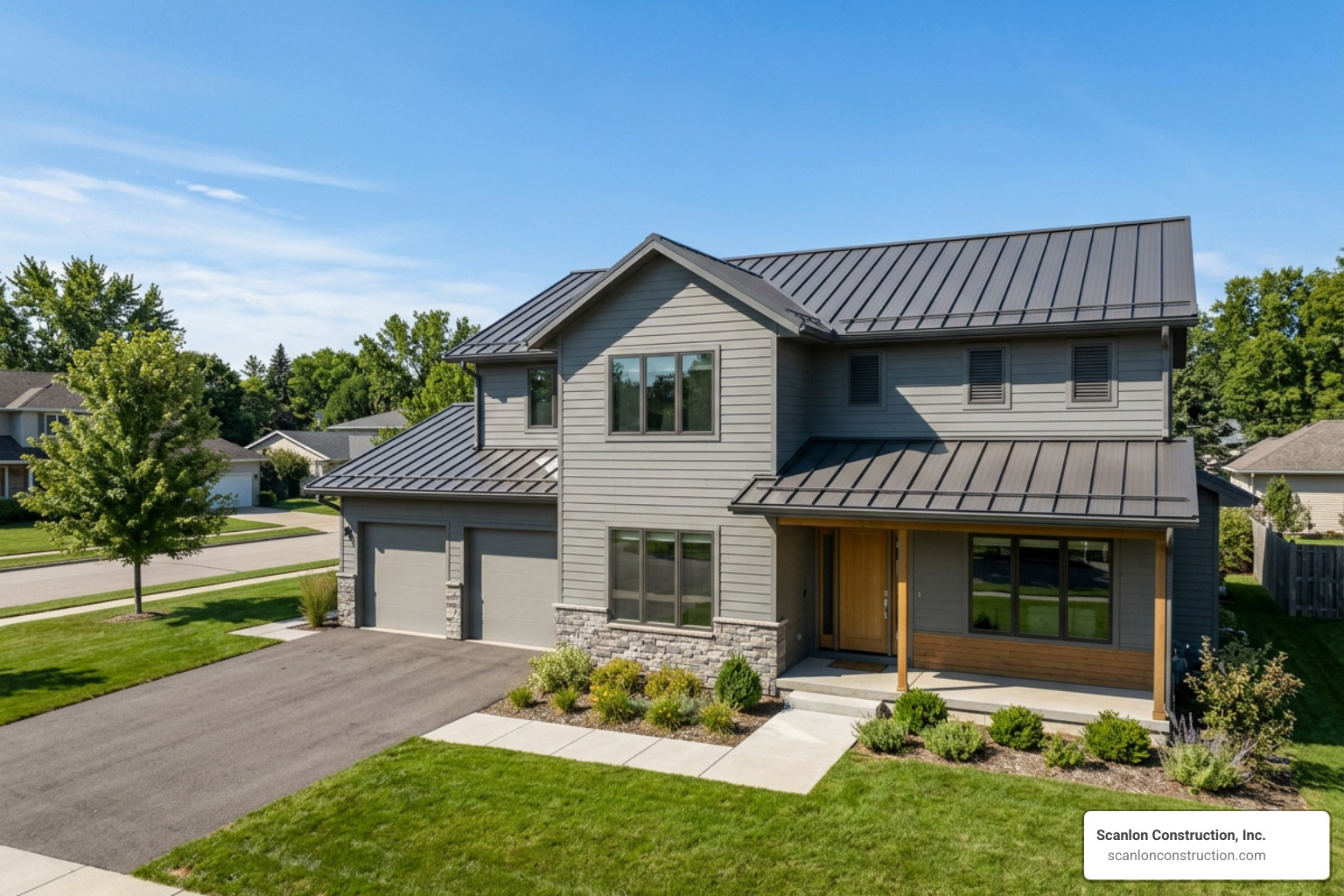
Key assemblies include:
- Roofing: Class A fire-rated standing seam metal, non-combustible concrete, or clay tile systems over high-temp underlayment.
- Vents: Ember-resistant, baffled exterior vents designed to prevent wind-driven embers from entering attics and crawlspaces.
- Exterior Cladding: Non-combustible fiber cement panels, authentic three-coat stucco, stone veneer, or fire-treated heavy timber assemblies.
- Glazing: Dual-pane or multi-pane windows with tempered safety glass and insulated metal frames to withstand extreme thermal shock.
- Interiors: Full NFPA-compliant residential fire sprinkler systems.
Note on Energy Codes: Rebuilt homes in Los Angeles are no longer subject to a blanket citywide all-electric construction mandate, meaning you can incorporate natural gas cooking, heating, and standby generation alongside your high-efficiency solar arrays.
Why Hiring a Local Fire Rebuild Contractor in Los Angeles Simplifies Permitting
Local builders understand how municipal inspectors operate, how regional microclimates affect materials, and how to work smoothly with LADBS One-Stop Rebuilding Centers. Choosing an established builder who provides comprehensive about custom design-build oversight keeps your architect, engineers, and site superintendents aligned through every inspection.
Budgeting, Insurance Scope Alignment, and Financial Assistance
Rebuilding after a wildfire requires careful alignment between your insurance policy limits and the real-world costs of building to current Los Angeles codes. You can learn more by submitting a contact request directly to our pre-construction estimating team.
Bridging the Insurance Claim Gap with Code-Upgrade Analysis
Insurance adjusters often create initial settlement scopes based on historical construction costs or regional databases that overlook current codes. The difference between an adjuster’s estimate and the true cost of rebuilding usually stems from mandatory modern upgrades, such as:
- New fire sprinkler systems.
- Title 24 solar and energy storage mandates.
- Foundation re-engineering and hillside soil stabilization.
- Chapter 7A WUI ignition-resistant exterior materials.
We review insurance scopes of loss line by line, comparing initial settlement offers with actual code-compliant construction costs. Using detailed architectural estimates, we help homeowners unlock Ordinance or Law coverage riders to bridge policy shortfalls.
City Fee Waivers, Supply Rebates, and Utility Coordination
To ease financial pressure on rebuilding homeowners, several local relief programs are available:
- LADBS Permit Fee Waivers: Plan check and permit fees are fully suspended for property owners who owned the home as of the date of the fire.
- Material Rebates: Material suppliers like Builders FirstSource offer dedicated fire rebates up to 3% on framing packages, windows, and doors for designated wildfire-affected zip codes (including 90049, 90272, 91001, 91104, 91106, 91107, 90265, 90290, and 90402).
- Critical Utility Coordination:
- LADWP permanent power hookups and underground service line conversion.
- SoCalGas line pressure testing, meter resetting, and mainline reconnection.
- Los Angeles Bureau of Sanitation sewer lateral scoping and backflow prevention checks.
- Fire hydrant flow tests and dedicated domestic water meter upsizing for fire suppression lines.
Frequently Asked Questions About Fire Rebuilds in Los Angeles
Can I reuse my existing concrete foundation after a wildfire?
In most cases, fire-damaged foundations cannot be safely reused without substantial retrofitting. High temperatures weaken the chemical bonds within cured concrete, cause structural spalling, and anneal structural steel rebar, compromising its tensile strength. A licensed structural engineer must complete core sampling and impact testing. If micro-fractures or heat compromises are detected, LADBS requires full foundation replacement.
What is the primary difference between EO1 and EO8 rebuilds?
Executive Order 1 (EO1) applies to like-for-like rebuilds that remain within 110% of the original home’s square footage, footprint, and height envelope, qualifying for expedited 5-day clearance approvals. Executive Order 8 (EO8) is intended for homeowners designing an entirely new or larger custom footprint. While EO8 plans must satisfy modern zoning, setback, and height limits, they still benefit from reduced administrative clearance requirements.
Are newly rebuilt fire-affected homes in Los Angeles required to be all-electric?
No. The citywide all-electric building mandate has been repealed. Homeowners rebuilding after a wildfire can install dual-fuel systems, natural gas cooking ranges, gas fireplaces, and hydronic heating alongside energy-efficient heat pumps, solar arrays, and battery backups under standard California Title 24 rules.
Conclusion
Rebuilding after a wildfire is a major undertaking, but with the right team, it is also an opportunity to build back stronger, safer, and with lasting architectural beauty. By taking advantage of city fee waivers, expedited executive orders, and modern fire-resilient materials, you can restore your home with complete confidence.
With over 30 years of experience crafting high-end luxury residences and guiding clients through disaster recoveries, we are here to support you at every stage of the journey. When you are ready to take the next step, partner with our specialized Pacific Palisades fire rebuild team to bring your vision home.