

A Comprehensive Guide to Luxury Remodel Ideas for Your Home
Defining Standard Renovation vs. High-End Transformation
A luxury remodel transforms a residence through bespoke architectural millwork, open-concept structural reconfigurations, custom gourmet kitchens, spa-grade wellness suites, and integrated smart home automation. Rather than basic cosmetic updates, high-end transformations re-engineer spatial flow and performance using premium natural materials and advanced building science.
A standard home renovation typically addresses surface-level wear and tear or cosmetic updates. It replaces old tile with new retail tile, swaps builder-grade cabinets for stock alternatives, and applies fresh coats of paint. While functional, standard renovations rarely alter the underlying flow, performance, or character of the property.
A high-end transformation fundamentally re-engineers how a home functions. Rather than settling for off-the-shelf components, it relies on custom craftsmanship, architectural millwork, and bespoke materials tailored to your exact daily routine. Instead of working around structural constraints, our design-build approach evaluates load-bearing configurations, allowing for structural wall removal to establish expansive, daylight-filled sightlines.
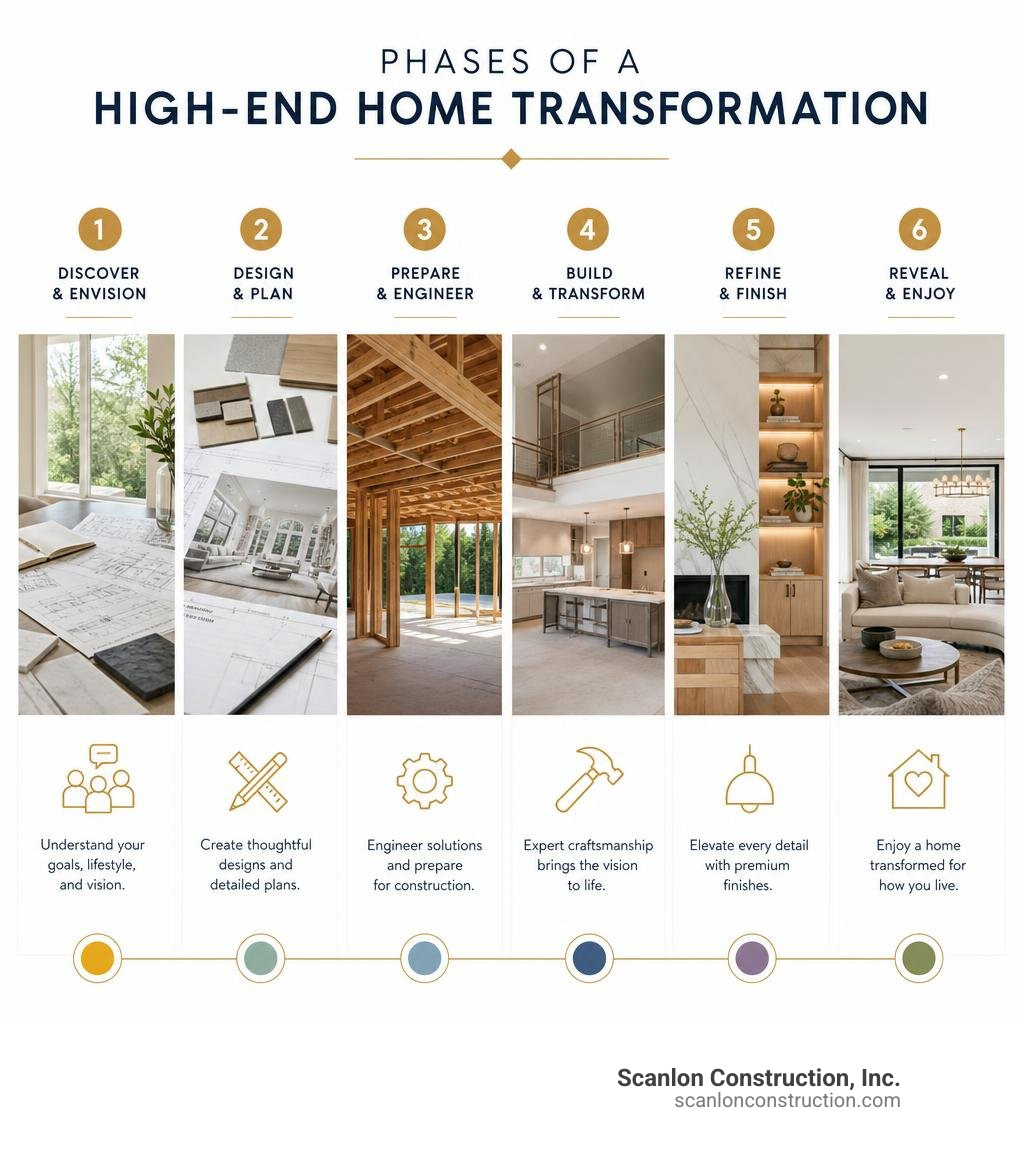
This level of remodeling combines aesthetic sophistication with advanced building science. We optimize spatial layouts, conceal complex MEP (mechanical, electrical, plumbing) infrastructure within clean architectural lines, and introduce premium natural finishes that age gracefully over decades.
Top Architectural and Design Trends for 2026
As we navigate 2026, residential architecture has moved past superficial ornamentation in favor of understated elegance, refined textures, and environmental performance. Affluent homeowners are investing in spaces that support holistic wellness, sustainability, and effortless entertaining.
- Biophilic Design and Natural Illumination: Integrating floor-to-ceiling glass, internal light wells, and natural elements like living accent walls to blur the boundary between indoor living and nature.
- Sustainable and Resilient Building: Incorporating high-efficiency thermal envelopes, non-toxic building materials, and micro-grid solar battery storage systems that enhance energy independence.
- Multi-Functional Flexible Spaces: Designing concealed pocket offices, acoustic-paneled music lounges, and convertible entertainment rooms that adapt throughout the day.
- Bespoke Architectural Millwork: Fluted paneling, integrated rift-cut oak cabinetry, hidden pivot doors, and custom ceiling treatments that lend distinct character to every room.
You can explore these spatial strategies across our completed high-end portfolio projects.
Essential Rooms to Transform in a Luxury Remodel

Certain spaces serve as the anchor points of daily living and deliver the greatest balance of personal enjoyment and property value:
- The Culinary Great Room: Today’s luxury kitchens function as social stages. We design gourmet cooking spaces featuring rift-cut white oak cabinetry, integrated architectural pantries (sculleries), commercial-grade induction cooktops, and book-matched quartzite waterfall islands.
- The Primary Wellness Suite: Modern primary bathrooms rival world-class day spas. Common upgrades include freestanding composite stone soaking tubs, dual-entry walk-in steam showers with digital thermostatic controls, high-tech bidet toilets, and custom floating vanities.
- Boutique Dressing Rooms: Transforming standard closets into customized dressing suites with integrated LED task lighting, glass-front display wardrobes, dedicated jewelry islands, and secure personal storage.
Bringing these elements together seamlessly requires experienced coordination across multiple trades through our comprehensive design-build services.
Smart Home Automation and Wellness Tech Integration
Modern luxury extends into the invisible technology managing your home’s micro-environment. With the global smart home market projected to reach US$154.4 billion in 2026, intelligent home automation has transitioned from a novelty to an essential architectural layer.
- Circadian Lighting Systems: Automated low-voltage LED networks adjust color temperature throughout the day to mirror natural sunlight patterns, promoting healthy sleep cycles.
- Whole-Home Climate and Radiant Heating: Hydronic radiant floor heating paired with concealed, multi-zone HVAC units provides silent, draft-free thermal consistency.
- Dedicated Wine and Tasting Rooms: Precision climate-controlled wine cellars maintain strict 55°F temperature and 65% humidity levels to protect rare vintages while doubling as architectural display features.
- Private Entertainment Venues: Custom acoustic-treated home theaters engineered with 4K laser projection, immersive Dolby Atmos audio, and automated motorized drapery.
Seamless Indoor-Outdoor Living and Custom Landscaping
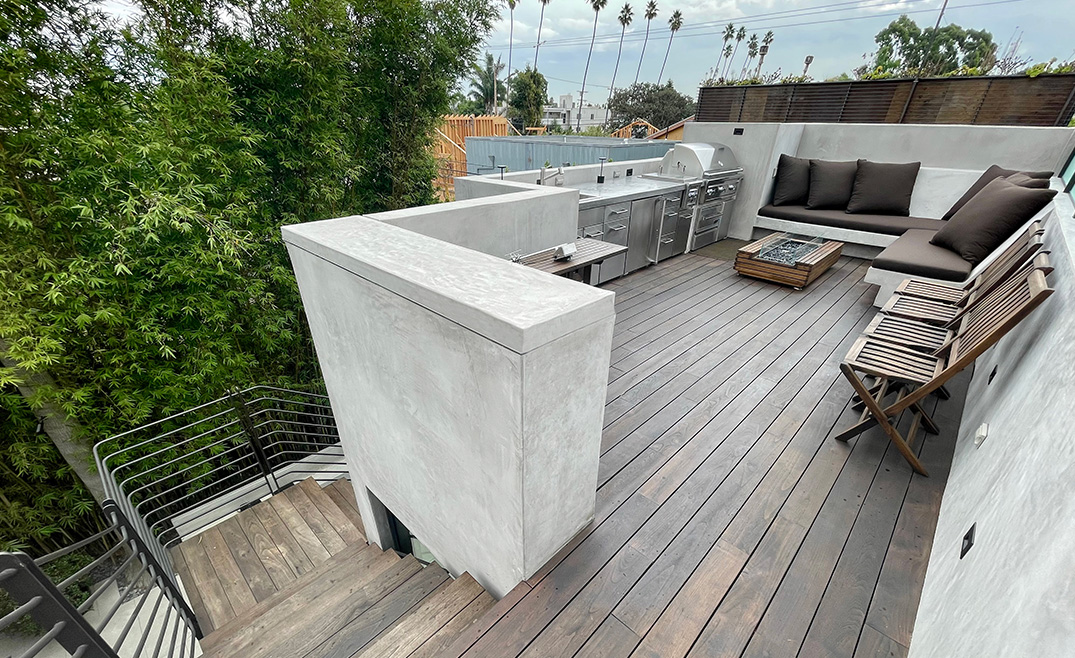
With over half of renovating homeowners prioritizing indoor-like outdoor spaces, modern remodels place heavy emphasis on seamless transitions to exterior areas. We frequently integrate multi-panel motorized pocketing glass doors that open entire living rooms directly onto stone loggias, cantilevered patios, and curated landscaping.
Exterior living areas now feature full architectural outdoor kitchens with marine-grade stainless cabinetry, built-in pizza ovens, sunken fire lounges, and zero-edge swimming pools. High-quality exterior planning is also a sound financial strategy; quality landscaping can increase overall home value by up to 12%.
Key Investment Factors and Costs for a Luxury Remodel
High-end remodeling budgets depend heavily on scope, structural complexity, and finish selections. In competitive, seismically active metro markets like California, comprehensive luxury whole-home remodels typically start at $275 to $400+ per square foot. Larger architectural transformations often range from $450,000 to over $1,000,000 when accounting for structural changes, luxury fixtures, and site challenges.
Several key factors shape the total investment:
- Structural Reconfiguration: Removing structural walls, lowering foundation slabs, or adding cantilevered steel moment frames requires substantial engineering and site labor.
- Infrastructure Upgrades: Replacing outdated copper plumbing, upgrading electrical service to 400 amps for EV charging and smart systems, and installing architectural HVAC ducting.
- Material Selection: Sourcing imported marble, custom slab quartzite, rift-sawn hardwoods, and custom metalwork directly influences raw procurement costs.
- Permitting and Municipal Compliance: Navigating seismic regulations, local environmental ordinances, and architectural review boards.
Achieving an exceptional result requires seasoned design-build professionals who understand how to coordinate large-scale architectural scopes smoothly from concept to completion.
Return on Investment for Kitchens, Baths, and Basements
While luxury remodeling is primarily driven by comfort and lifestyle, industry cost-value benchmarks show strong financial cost recovery across major living zones:
- Kitchen Remodels: A high-end kitchen renovation typically recovers about 67% of its initial cost upon resale, serving as the primary selling point for prime residential properties.
- Spa Bathrooms: High-end bathroom remodels add 53% to 58% of their renovation spend directly to the property’s appraised market value.
- Walk-In Closet Suites: Custom dressing room build-outs show a strong cost recovery rate of 83%.
- Basement and Lower-Level Conversions: Converting an underutilized basement or ground level into a functional living space, entertainment lounge, or guest suite recovers an estimated 86% of the project cost when selling.
High-End Flooring and Premium Material Benchmarks
Flooring serves as the visual and tactile foundation of every interior space. High-end residential architecture favors wide-plank European white oak, natural stone slabs, and large-format porcelain that integrate cleanly with radiant in-floor heating systems.
| Flooring Material | Aesthetic Profile | Durability & Maintenance | Ideal Living Zones | Relative Cost Benchmark |
|---|---|---|---|---|
| Wide-Plank European Oak (Rift & Quartered) | Warm, organic, timeless; minimalist grain lines | High durability; can be refinished multiple times | Great rooms, bedrooms, dining suites, home libraries | Premium ($$$) |
| Honed Natural Stone (Marble, Quartzite, Limestone) | Formal, architectural, cooling touch | Requires periodic sealant; highly durable against wear | Entry foyers, primary bathrooms, wine tasting rooms | High-End ($$$$) |
| Large-Format Porcelain Slabs | Contemporary, ultra-clean, minimal grout | Extreme scratch and moisture resistance; easy maintenance | Indoor-outdoor transitions, secondary baths, mudrooms | Moderate to Premium ($$) |
| Architectural Terrazzo | Bespoke aggregate patterns; artisanal modernism | Lifetime durability; highly resistant to foot traffic | Kitchens, sunrooms, mid-century modern living zones | High-End ($$$$) |
Managing Execution: Timelines, Permitting, and General Contractors
A luxury renovation is a major logistical undertaking that requires experienced project management. Unforeseen structural challenges, long material lead times, and complex municipal building departments require a seasoned general contractor to keep the project on track.
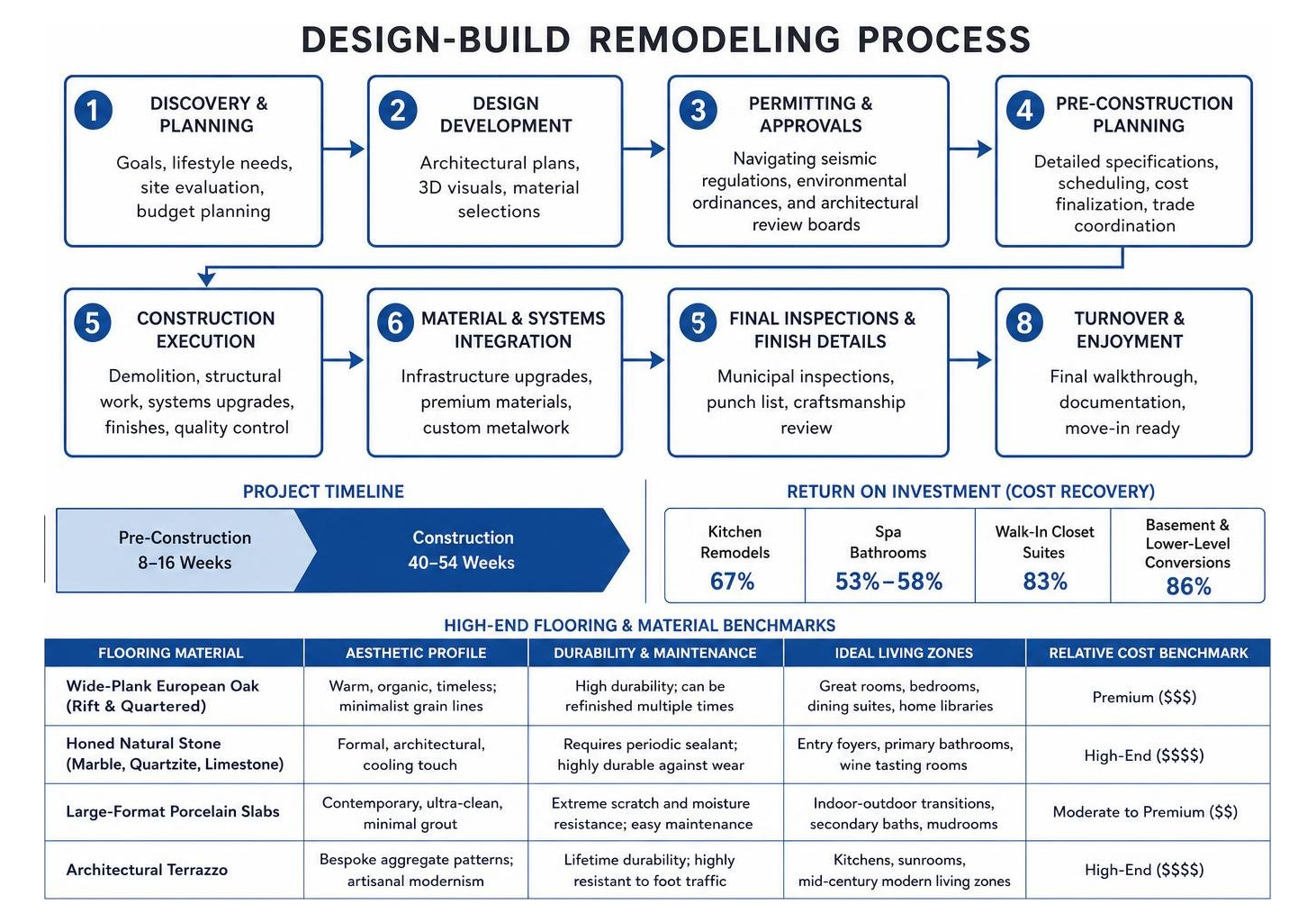
Our team manages the entire process from initial architectural sketches to final finish details, drawing on decades of experience with complex hillside sites, specialized structural repairs and home restoration, and detailed site feasibility and property evaluation.
Timeline and Planning Stages for a Luxury Remodel
A complete high-end whole-home transformation typically takes between 40 and 54 weeks of active construction, with an additional 8 to 16 weeks of pre-construction design and permitting.
- Phase 1: Concept & Architectural Engineering (Weeks 1–12): Spatial planning, 3D renderings, structural calculations, and mechanical engineering layouts.
- Phase 2: Permitting & Material Procurement (Weeks 13–24): Submitting plans to municipal building departments while placing long-lead orders for custom cabinetry, imported stone, windows, and luxury plumbing fixtures.
- Phase 3: Structural Framing & Rough Trades (Weeks 25–36): Demolition, structural framing, wall removals, electrical rewiring, plumbing reconfiguration, and HVAC installation.
- Phase 4: Architectural Finishes & Millwork (Weeks 37–48): Drywall, stone slab fabrication, custom millwork installation, hardwood flooring, and tile setting.
- Phase 5: Fixtures, Commissioning & Detailing (Weeks 49–54): Appliance hookups, smart system automation programming, fixture detailing, final inspections, and white-glove punch list completion.
Selecting a Qualified Design-Build Team
Hiring the right partner protects both your investment and your peace of mind. When evaluating general contractors and design-build firms for a luxury project, make sure to review the following:
- Licensing & Clean Record: Verify active licensing with the California Contractors State License Board (CSLB) and confirm clear workers’ compensation and general liability policies.
- Architectural Collaboration: Look for a team with a proven history of executing complex architectural drawings alongside reputable interior designers and structural engineers.
- Transparent Budgeting: Demand detailed scopes of work with clear change-order policies to avoid unexpected mid-project surprises.
- Sustainability Credentials: Ensure the builder understands high-performance insulation, clean indoor air standards, and green building techniques.
Frequently Asked Questions About High-End Renovations
What distinguishes a luxury remodel from a standard renovation?
A standard renovation focuses on surface-level, cosmetic updates using prefabricated materials within existing room layouts. A high-end remodel involves complete spatial re-engineering, structural wall modifications, custom architectural millwork, bespoke materials like book-matched natural stone, integrated smart-home automation, and high-performance building infrastructure.
What is the expected ROI for high-end kitchen and bathroom remodels?
On average, a high-end kitchen remodel recovers approximately 67% of its initial cost at resale, while a primary spa bathroom renovation recoups between 53% and 58% in direct home value. In competitive luxury real estate markets, these updated spaces often serve as the deciding factor for prospective buyers, significantly accelerating sales timelines.
How long does a luxury whole-home remodel typically take?
A luxury whole-home remodel generally takes between 50 and 54 weeks of active construction. When including initial architectural concept design, engineering, municipal plan check reviews, and permitting, homeowners should budget 12 to 18 months for the total project lifecycle.
Conclusion
Transforming an upscale residence into a personalized sanctuary requires balancing an ambitious architectural vision with disciplined construction management. By focusing on smart space planning, sustainable materials, modern automation, and artisan-level craftsmanship, your home becomes a deeply comfortable retreat that retains lasting market value.
When you are ready to explore the architectural possibilities for your residence, connect with Scanlon Construction to begin planning your design-build transformation.