

In Depth Guide to High-End Renovation Services
Planning and Budgeting for a High-End Renovation
High-end renovation services encompass integrated design-build planning, complete structural and MEP (mechanical, electrical, plumbing) infrastructure overhauls, and bespoke architectural finishes—all coordinated under a single team to transform a residence into a personalized, high-performance home. A successful luxury remodel begins with aligning your vision to a realistic financial framework, then moves through pre-construction design, permitting, full construction execution, and final handover. Understanding how to structure your budget is the essential first step.
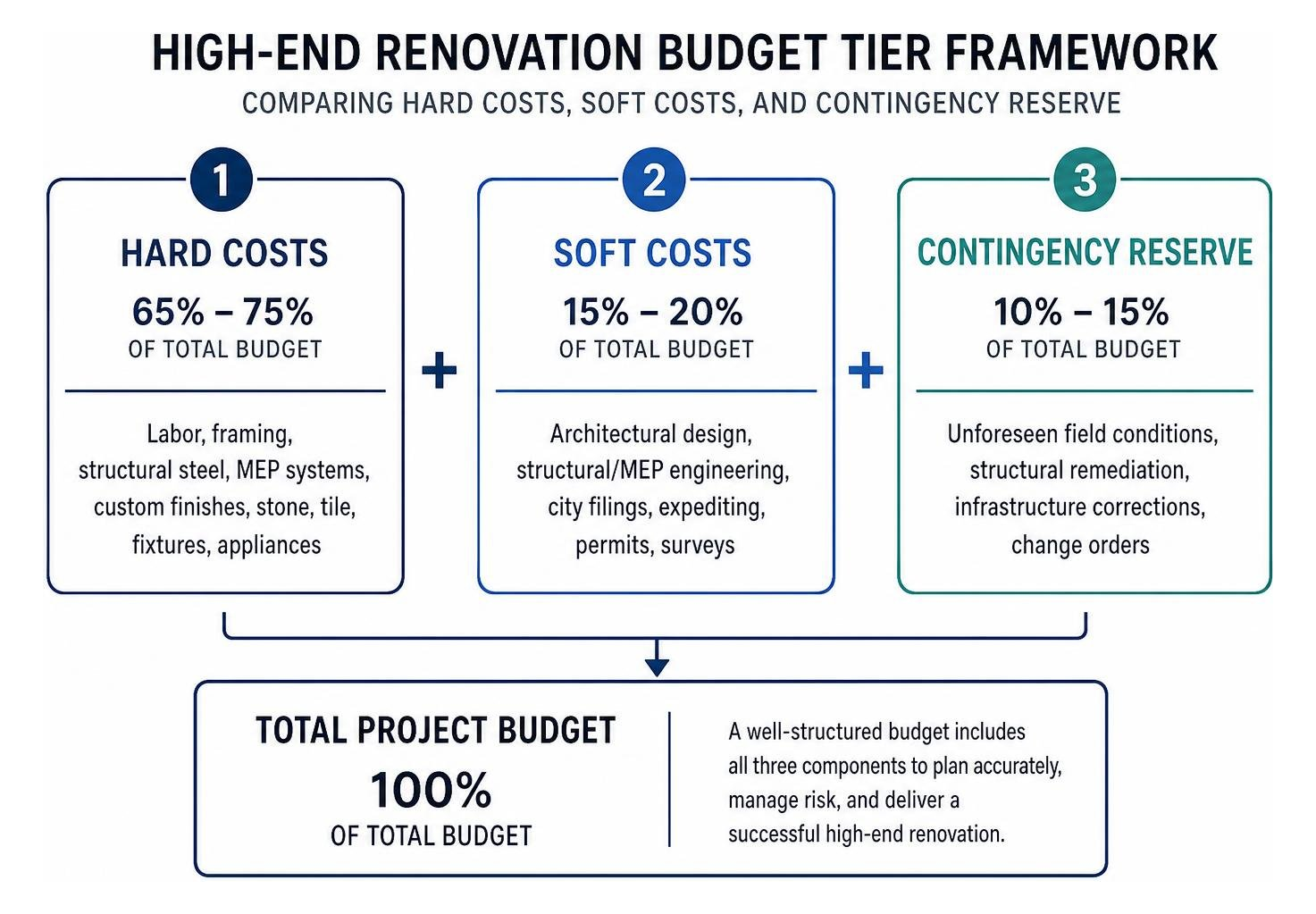
A luxury residential transformation requires financial discipline from the very beginning. When planning your budget, it is critical to distinguish between hard costs and soft costs.
Hard costs represent the physical build: demolition, concrete framing, structural steel, mechanical installations, artisan millwork, slab stone, appliances, and trade labor. Labor alone typically accounts for 30% to 50% of the overall construction budget.
Soft costs cover everything required before and alongside the build: architectural design fees, structural and MEP engineering, municipal permit applications, expediting services, historic preservation reviews, and environmental testing (such as asbestos or lead abatement). In major urban centers, soft costs reliably account for 15% to 20% of your total budget.
A well-structured budget must also include a dedicated contingency reserve of 10% to 20%. When opening walls in older or custom homes, unexpected structural shifts, degraded plumbing, or outdated wiring are not just possibilities—they are practically guaranteed.
| Budget Category | Description | Typical % of Total Budget |
|---|---|---|
| Hard Costs | Labor, framing, structural steel, MEP systems, custom finishes, stone, tile, fixtures, appliances | 65% – 75% |
| Soft Costs | Architectural design, structural/MEP engineering, city filings, expediting, permits, surveys | 15% – 20% |
| Contingency Reserve | Unforeseen field conditions, structural remediation, infrastructure corrections, change orders | 10% – 15% |
Critical Factors Defining a High-End Renovation Project
True luxury is defined by craftsmanship, precision, and performance rather than a brand label on a faucet. Several distinct factors drive the complexity and cost of a high-end remodel:
- Design Complexity & Reconfiguration: Removing load-bearing partitions, raising ceiling heights, or installing floor-to-ceiling glass curtain walls requires complex structural steel and engineered foundation footings.
- Bespoke Millwork & Custom Fabrication: From rift-sawn white oak cabinetry with integrated hardware to hidden pocket doors and paneled appliance walls, custom woodwork requires weeks of workshop fabrication and master-carpenter installation.
- Full-Slab Stone Execution: Installing bookmatched marble, quartzite, or porcelain slabs across kitchen islands, backsplashes, and full bathroom wet rooms requires specialized laser templating, reinforced framing, and precise alignment.
- MEP Engineering & Infrastructure Overhauls: Upgrading older homes requires completely modern mechanical backbones: 200–400 AMP electrical services, low-voltage smart automation wiring, multi-zone heat pump systems, and robust plumbing with leak-detection shut-off sensors.
- Architectural Lighting & Performance Envelope: High-end renovations combine ambient, task, and accent lighting with premium high-CRI fixtures, motorized shades, triple-pane acoustic windows, and continuous thermal insulation.
High-End Renovation Cost Benchmarks: NYC, DC, and Los Angeles
Luxury renovation costs reflect regional labor rates, municipal permitting stringency, and supply chain logistics across major metropolitan areas:
- New York City: A high-end apartment renovation starts around $550 per square foot, with custom co-op and brownstone gut renovations frequently reaching $750 to $1,000+ per square foot. A full gut renovation of a ~1,800-square-foot pre-war apartment with luxury finishes ranges from $850,000 to well over $1,500,000 for complex transformations.
- Washington, DC: A full-home luxury gut renovation in the District typically ranges from $400,000 to $3,000,000, with major additions and basement conversions adding $200,000 to $900,000 depending on structural scope.
- Los Angeles & Southern California: Whole-home luxury transformations regularly range from $450,000 to $1,500,000+ ($275 to $600+ per square foot), driven by strict seismic building codes, Title 24 energy mandates, and hillside engineering demands.
Understanding critical budget thresholds is essential. A critical budget threshold occurs when an incremental aesthetic upgrade creates an exponential spike in cost. For instance, jumping from an exceptional 10-inch wide-plank engineered oak floor to a 12-inch rare-milled solid plank can double flooring material costs across a 4,000-square-foot home with minimal visual difference. When planning through our bespoke residential services, identifying these thresholds early helps allocate capital where it delivers genuine aesthetic and structural value.
Full Gut Renovation vs. Partial Remodel: Structural and Mechanical Upgrades
A common dilemma is whether to execute a targeted cosmetic remodel or undertake a complete gut renovation down to the studs.
If your home’s underlying layout works well and the mechanical systems are modern, a targeted partial remodel focused on kitchens, baths, and interior surfaces is practical. However, if you are altering room configurations, addressing sagging floor joists, expanding ceiling heights, or upgrading outdated infrastructure, a full gut renovation is the far more cost-effective and enduring choice.
In pre-war homes and mid-century residences, applying expensive surface finishes over failing infrastructure is a recipe for disaster. A full gut renovation allows us to address:
- Plumbing Infrastructure & Water Pressure: Older properties often suffer from water pressure as low as 20 psi. Overhauling vertical supply lines and installing dedicated booster pumps ensures a constant, luxurious 55 to 60 psi across multi-head steam showers and soaking tubs.
- Electrical Capacity: Modern luxury residences require significant power for induction cooktops, dual electric vehicle chargers, integrated audio-visual racks, and multi-zone HVAC systems, necessitating full panel upgrades to 200 or 400 AMPs.
- Acoustic Isolation: Gutting walls allows for high-performance sound dampening, including mineral wool acoustic batts, resilient isolation channels, and acoustic subfloor underlayments that eliminate sound transmission between living suites.
Historic Restoration and Structural Remediation
Restoring historic townhomes, classic Spanish revivals, or mid-century architectural masterpieces requires deep respect for original materials combined with modern engineering.
Demolition in older structures often reveals century-old brick mortar that has turned to dust, non-level foundations, or legacy hazardous materials like floor mastic containing asbestos, which requires certified remediation protocols prior to rebuild. Leveling unlevel subfloors and reinforcing timber framing with engineered LVL beams ensures that your new wide-plank hardwood or large-format slab tiles never crack or bow. Our extensive experience with rebuilding and structural renovation strategies has shown that structural integrity must always precede interior aesthetics.
Space Optimization and Additions
Maximizing usable square footage enhances everyday livability while creating significant real estate equity:
- Building Up vs. Building Out: Expanding outward adds single-level convenience, but building upward adds expansive master suites and roof decks while preserving valuable backyard outdoor living space.
- Luxury Basement Conversions: Transforming an underutilized, dark cellar into a conditioned lower-level entertainment lounge, wine cellar, home theater, or wellness spa offers an impressive 86% ROI.
- Garage ADU Conversions: Converting a detached garage into a high-end Accessory Dwelling Unit ($200,000 to $700,000) creates a versatile, private guest house, creative studio, or rental property.
- Seamless Indoor-Outdoor Flow: Installing motorized multi-slide pocket doors that vanish into wall cavities connects interior great rooms directly to covered outdoor loggias, pools, and fire features.
High-Impact Architectural Spaces and High-ROI Luxury Upgrades

Investing in your home should deliver both daily personal enjoyment and substantial long-term financial equity. Between 2020 and 2023, median renovation spend surged by 60%, with over 51% of renovating homeowners spending $25,000+ on individual high-impact projects. Selecting the right spaces to upgrade ensures optimal cost recovery upon resale.
Gourmet Kitchens and Spa-Inspired Bathrooms
The kitchen remains the social and culinary centerpiece of the luxury home. High-end kitchen renovations typically recoup approximately 67% of their investment at resale. Essential elements include:
- Integrated, custom paneled luxury appliances (Sub-Zero, Wolf, Miele, Gaggenau) flush with surrounding cabinetry.
- Generous central islands with waterfall quartz or natural quartzite slabs, serving as food preparation zones and social anchors.
- Customized storage solutions, including motorized pocket appliance garages, walk-in butler pantries, and solid wood drawer organizers.
In the primary bathroom, spa-inspired upgrades deliver a return of 53% to 71%. Today’s luxury primary bathrooms feature zero-threshold, curbless wet rooms that enclose a freestanding soaking tub and multi-head walk-in shower behind frameless Starphire ultra-clear glass. When paired with radiant underfloor heating ($6 to $20/sq ft), integrated bench seating, and wall-hung smart toilets, the space becomes a true personal wellness retreat.
Specialty Living Spaces and Exterior Enhancements
Beyond kitchens and baths, specialized lifestyle spaces deliver high aesthetic and practical value:
- Custom Walk-In Dressing Rooms: Bespoke closet buildouts yield an astonishing 83% cost recovery, featuring integrated LED display shelving, glass vitrines, center islands with velvet-lined jewelry drawers, and automated wardrobe lifts.
- Climate-Controlled Wine Storage: Custom architectural glass-enclosed wine rooms turn collections into dramatic visual focal points while maintaining temperature and humidity stability.
- Smart Home Automation & Security: The global home security and smart automation market is projected to reach $84.4 billion by 2027. Integrating discrete motorized shades, centralized Lutron lighting control, and enterprise-grade networking provides effortless comfort and peace of mind.
- Exterior Envelopes & Landscaping: First impressions matter. Upgrading exterior cladding with architectural fiber cement siding or natural stone, building expansive composite deck terraces, and installing professional landscaping can increase overall property value by up to 12%.
Navigating Historic Codes, Permitting, and Building Logistics
High-end renovations in established neighborhoods or historic multi-family buildings come with rigorous regulatory oversight. Successfully delivering a project requires managing these milestones proactively:
- Landmark Preservation Approvals: Work altering exterior facades, historical windows, or visible rooflines requires Certificate of Appropriateness filings and historical commission reviews.
- Municipal Building Permits: Obtaining plan-check approvals for structural engineering, architectural modifications, Title 24 energy compliance, electrical load calculations, and mechanical ventilation.
- HOA & Co-op Alteration Agreements: Multi-unit luxury buildings require strict adherence to security protocols, service elevator booking schedules, trade credentialing, and water shut-off guidelines.
- Urban Material Logistics: In tight urban footprints, getting heavy materials into upper floors often requires mobile crane or boom truck deliveries through structural window openings rather than narrow historic stairwells.
- Top-Down Construction Phasing: In multi-story gut renovations, sequencing rough-in work and finishes from the top floor downward protects finished lower levels from accidental water leaks or construction traffic.
Choosing the Right Design-Build Partner for Luxury Remodeling
A high-end renovation involves dozens of skilled craftspeople, complex engineering, and hundreds of individual material selections. Hiring a disjointed group of independent designers, architects, and trade subcontractors often leads to communication gaps, scheduling finger-pointing, and unexpected budget expansion.
The integrated design-build delivery model unites architectural planning, structural engineering, interior design, permitting, and general contracting under a single, accountable team.
When evaluating a partner for your custom transformation, verify the following:
- Proven Local Track Record: Ensure they have extensive experience navigating your specific municipal building department, local zoning laws, and historic guidelines.
- Architectural Collaboration: Look for a firm that values design excellence and collaborates seamlessly with renowned architects and interior designers.
- Transparent Estimating & Change-Order Controls: A reputable builder provides comprehensive, itemized cost allocations upfront, minimizing surprise change orders during construction.
- Active Construction Administration: Ensure your partner provides dedicated on-site project management, rigid daily quality control, and detailed punch-list closeout procedures.
You can explore our extensive portfolio of custom transformations to see how precision craftsmanship and dedicated management bring ambitious designs to life.
Frequently Asked Questions About Luxury Home Remodeling
What is the typical cost per square foot for a luxury home remodel?
High-end residential renovations typically start between $275 and $550 per square foot for upper-tier finishes. Full-scale, ultra-luxury gut renovations featuring custom structural steel, imported full-slab stone, bespoke architectural millwork, and advanced mechanical systems frequently range from $600 to over $1,000 per square foot, particularly in complex metropolitan markets.
How long does a whole-home high-end renovation take to complete?
A comprehensive whole-home luxury renovation generally takes 6 to 12+ months for physical construction, following a 2- to 4-month pre-construction phase dedicated to architectural drawings, material procurement, and municipal permitting. Projects involving historic landmark approvals, major foundation additions, or complex structural changes can take 12 to 18 months.
What luxury home improvements yield the highest return on investment?
Custom walk-in closet conversions lead interior remodels with an 83% cost recovery, followed closely by luxury basement conversions (~86%), gourmet kitchen remodels (~67%), and primary spa bathroom renovations (53%–71%). Exterior upgrades—such as premium composite decking and architectural landscaping—can also boost overall property equity by up to 12%.
Conclusion
A high-end renovation is an investment in your daily quality of life, architectural beauty, and long-term property equity. By understanding the distinction between hard and soft costs, prioritizing essential structural infrastructure alongside luxury finishes, and planning with realistic timelines, you can transform your home into a personalized masterpiece.
At Scanlon Construction, we combine over 30 years of master craftsmanship, sustainable green building practices, and integrated project management across Los Angeles. Whether you are reconfiguring a historic residence or crafting an open-concept architectural sanctuary, our team is dedicated to bringing your vision to life with precision and lasting quality.